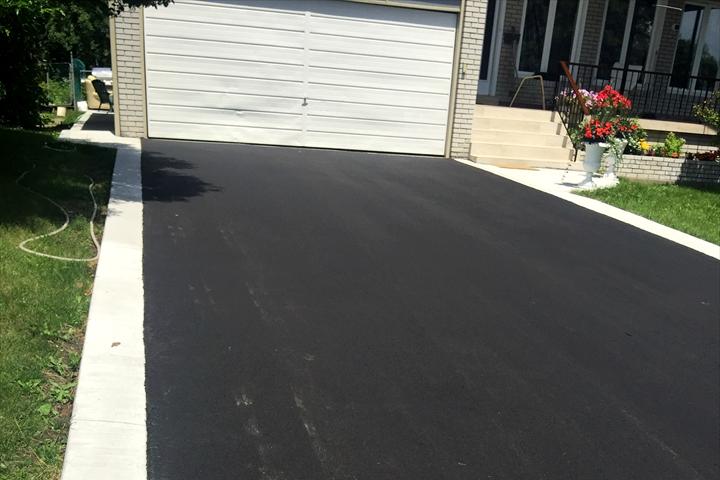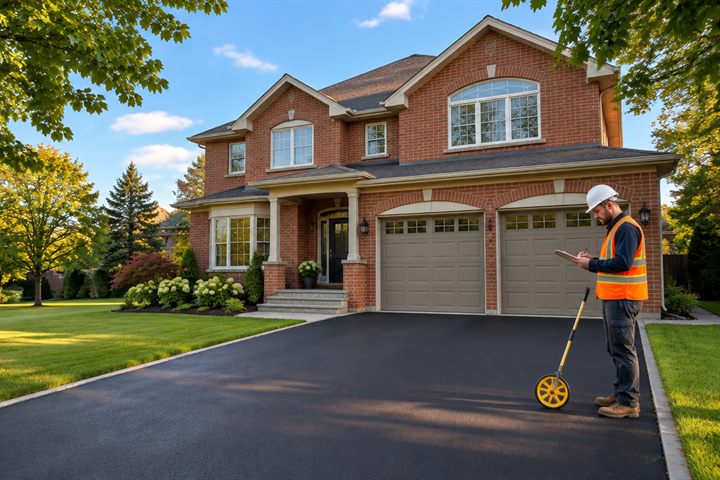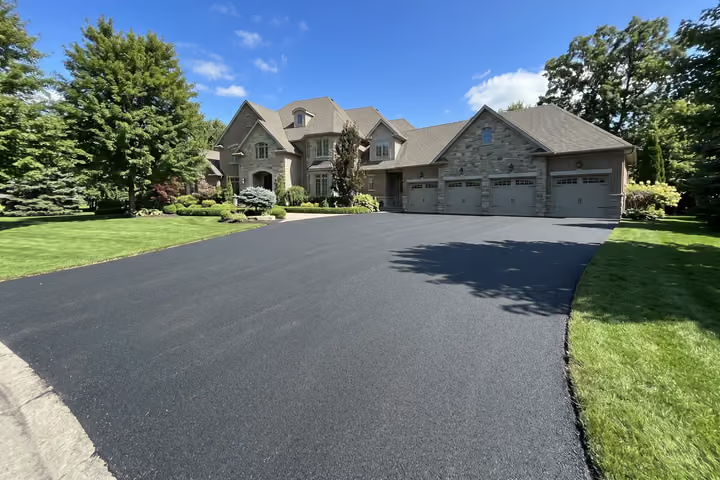
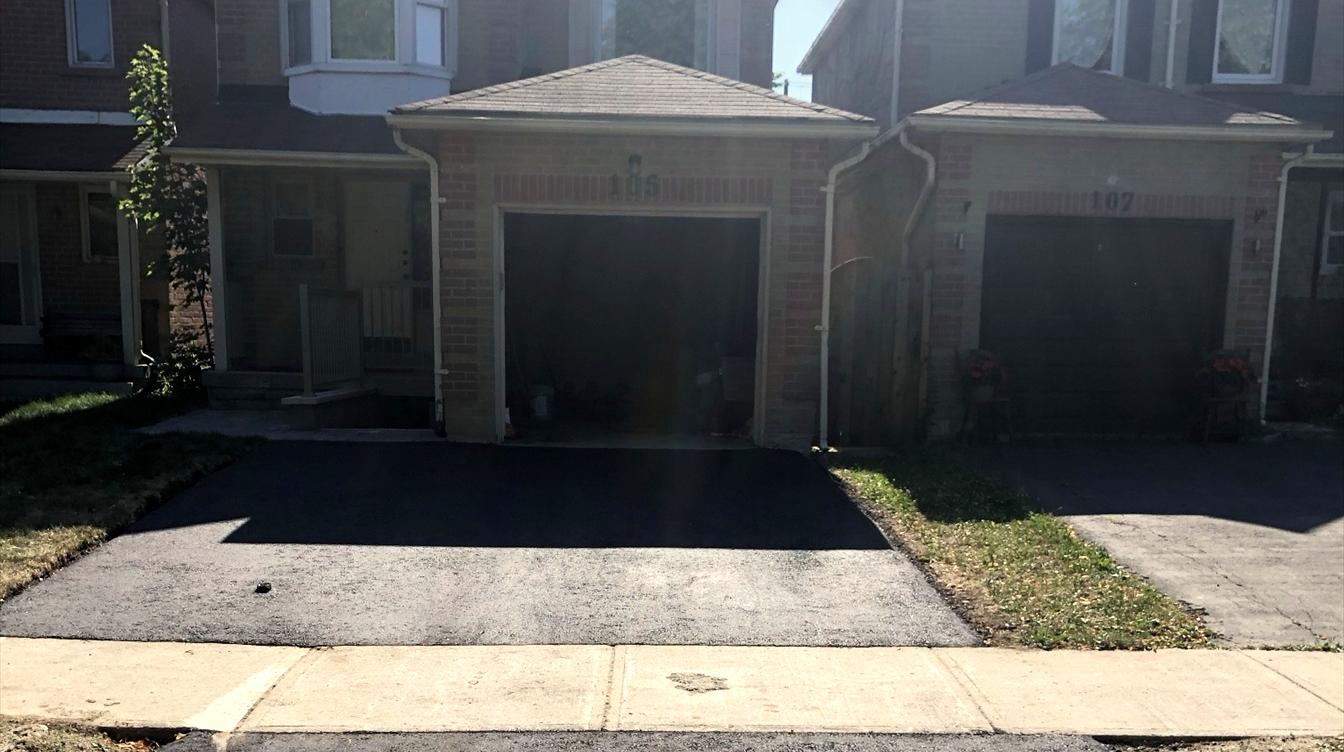
Adding room for a second car is mostly a base job. The lawn or garden beside your driveway has no stone under it, so the new area is dug out and built like a new driveway. Then, on almost every widening we do, the whole driveway is repaved, old footprint and new area together, as one surface. There’s no seam between old and new, the colour is even, and the slope is set once across the full width.
What can be built
Widening one side or both
Widening one side is the most common choice: one extra car width, usually on the side away from the house. Widening both sides keeps the driveway centred on the garage and can look more balanced, but it uses twice as much front yard and gives you two outside edges to support. On a narrow lot, one side is often all that fits between the driveway and the walkway.
Adding a parking pad
A parking pad is a paved space beside the driveway or off a side lane, built on its own excavated base like any widening. A pad next to the driveway is paved in the same pass as the rest. One that stands apart has every edge exposed, so it needs firm backfill all the way round, because unsupported asphalt edges crumble where tires roll over them.
Extending to the garage or backyard
Some driveways stop short of the garage, or end at the side of the house where you want to reach a backyard shed, trailer spot or side door. Drainage matters even more here: side yards are often where the lot’s drainage swale runs, and the new section must not send water toward the house or onto a neighbour’s lot.
Why we repave the whole driveway
- No seam in the wheel path. New asphalt doesn’t fuse to old. A strip added beside an existing driveway meets it along a joint, and that joint usually sits where the tires run. Water gets into it, freezes, and opens it a little more each winter.
- Old and new age together. A strip beside a 10-year-old driveway is at a different stage of its life. The old side cracks and settles first and pulls away from the new.
- One colour. New asphalt is deep black and older asphalt has faded to grey. A strip on its own shows that difference for years.
- One slope. Paving the full width lets the slope be set once, so water runs off toward the street and doesn’t collect where the old edge used to be.
- The base gets a second look. With the old asphalt off, any soft spot under it is dug out and rebuilt in the same job, so the old part of the driveway isn’t the weak half.
The extra cost is mostly the square footage of the existing driveway, since the crew, the equipment and the asphalt delivery are already there. The cost guide shows how the size of the job moves the price.
How a widening is built
- Locate buried services. Gas, hydro, cable and water lines can run under a front lawn, so they’re located and marked before any digging.
- Remove the old asphalt. It’s broken out and hauled away, and the base under it is checked. Soft or wet spots are dug out.
- Dig out the new area. The lawn or garden being paved has no base at all. Topsoil holds water and compresses under a car, so all of it comes out, down to firm ground.
- Build the base across the full width. Crushed granular stone goes in to the depth stated in your quote, compacted in layers, and shaped so water runs away from the house. The new area gets the same depth as the rest, so the whole driveway settles evenly.
- Pave and roll. The whole driveway is paved with HL3 hot mix and rolled while it’s hot, as one mat.
- Finish the edges. The edges are backfilled and compacted against the asphalt so they’re supported.
Drainage and edges
More asphalt means more water running off it, and a widening changes where that water goes.
- Slope away from the house. The new area is graded so runoff heads to the street or a lawn area, not toward the foundation, a window well or the garage floor.
- Downspouts. A downspout that used to empty onto the lawn may now empty onto the new asphalt. Redirect it or plan for it, because a steady stream across the surface wears it out faster.
- The lawn side. Where the widening meets grass, the edge is backfilled and compacted so it doesn’t break off under tires. Topsoil and sod brought up to the asphalt edge keep it supported.
- Against a walkway or garden bed. Any edge that sits higher or lower than the ground next to it collects water. Setting the heights right on the day is far easier than fixing a puddle later.
Shapes that hold up
A straight widening along the full length is the simplest to build and the easiest to compact evenly. A flare that widens only near the garage gives room to turn or park a second car without paving the whole front yard. A turnaround pad at the top lets you drive out forwards on a busy street.
Gentle curves work better than tight inside corners. A roller can’t reach right into a sharp corner, so that spot ends up less compacted and is usually where cracking starts.
What to have ready before you ask for quotes
- Your survey, if you have it. It shows where your lot lines are, which helps when the widening runs close to a fence or a neighbour’s driveway.
- Current and wanted widths. Measure the driveway now and mark where you’d like the new edge.
- Where water goes in heavy rain. Note any puddles, the downspouts near the driveway and which way the lawn slopes.
- Trees near the new area. Roots under a new base can lift it, and digging close to a tree can damage the roots. Point out any tree within a few metres of where you want to widen.
- Anything buried. Sprinkler lines, lighting cables and drainage pipes in the area to be dug. Public utilities are located before digging; private lines are up to you to point out.
Send your address, the measurements and a photo of the front of the house through our contact page. The free written estimate covers the widened driveway as a whole: the new area and the existing driveway, paved together.