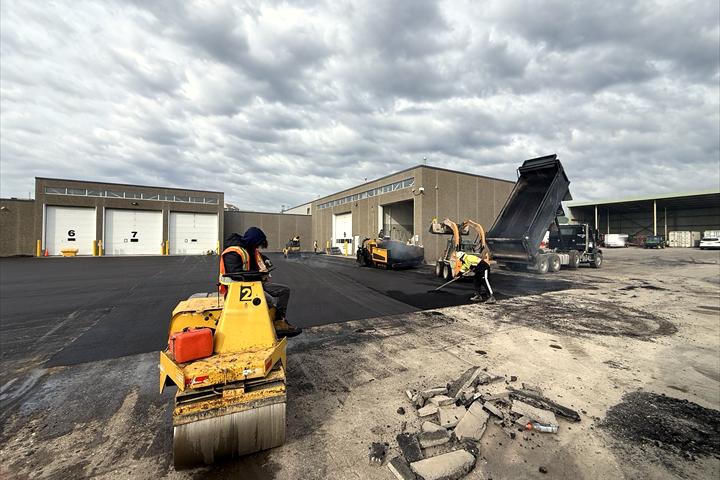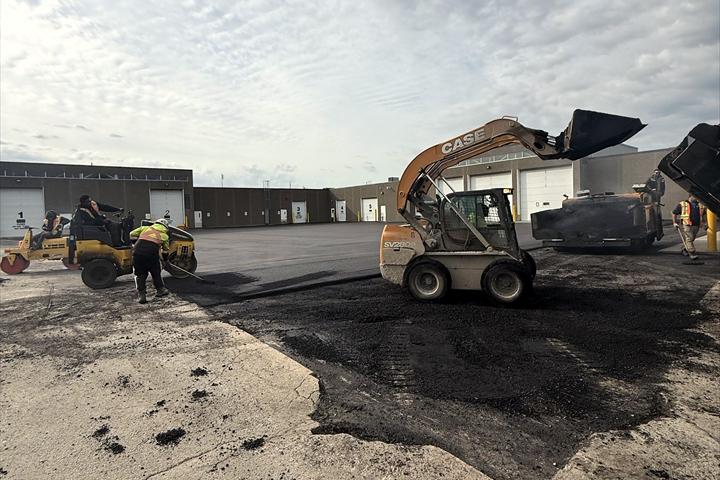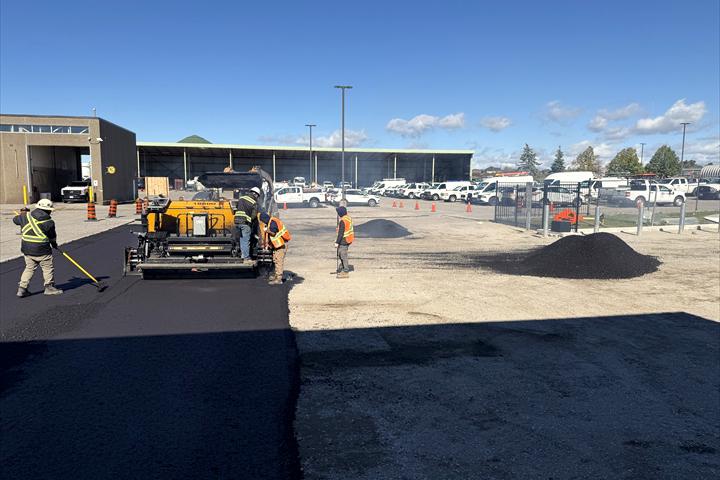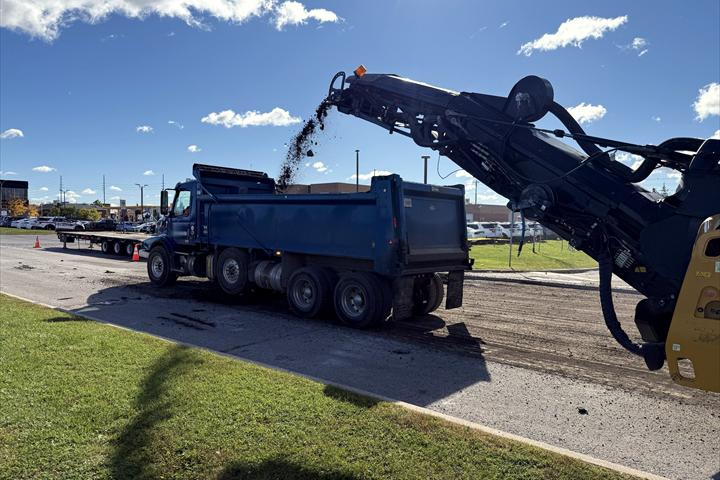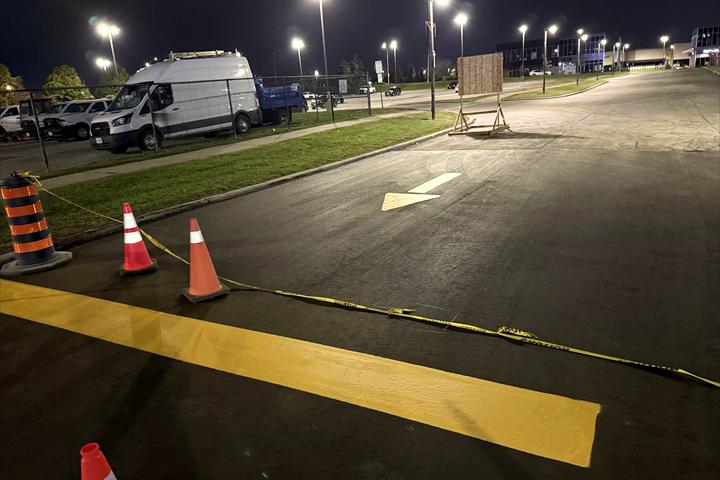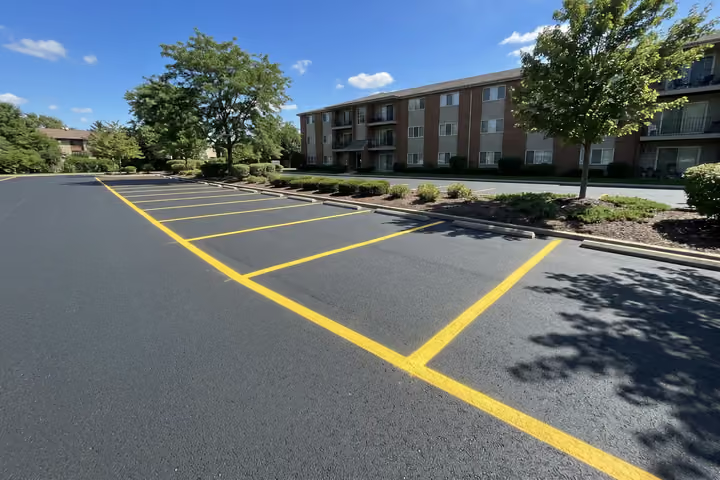
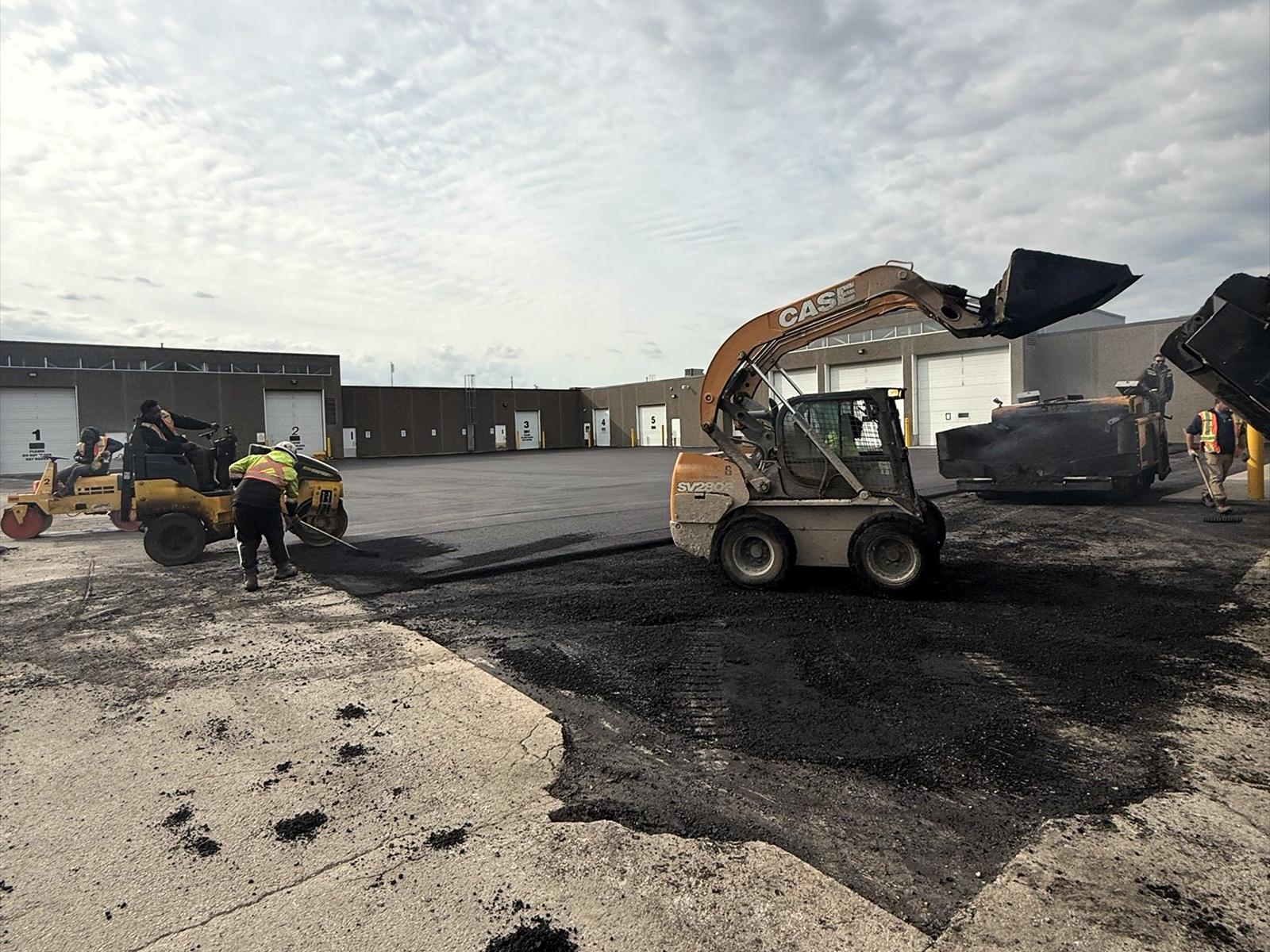
A truck court that ruts, a catch basin that ponds, stall lines nobody can read: in Concord, those are everyday operating problems, and each one has a usual cause. Concord has long been one of Vaughan’s main employment and rail areas, and we do industrial paving here as well as parking lots for offices, plazas and warehouses.
What fails first, and why
Most Concord lots show the same handful of defects. Each points to a cause, and the cause decides the fix:
| What you see | What usually causes it | The usual fix |
|---|---|---|
| Ruts in truck lanes and at docks | A base too thin for the loads, or water in the base | Cut out and rebuild, deeper where trucks run |
| Ponding after rain | A settled area, or a sunken or blocked catch basin | Regrade the low spot; catch basin repair |
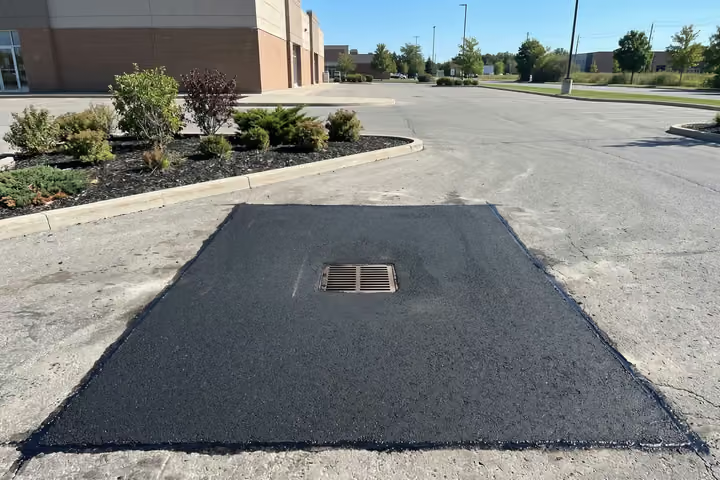
| Potholes around catch basins | Water getting under the asphalt at a cracked frame | Rebuild the frame and the asphalt around it |
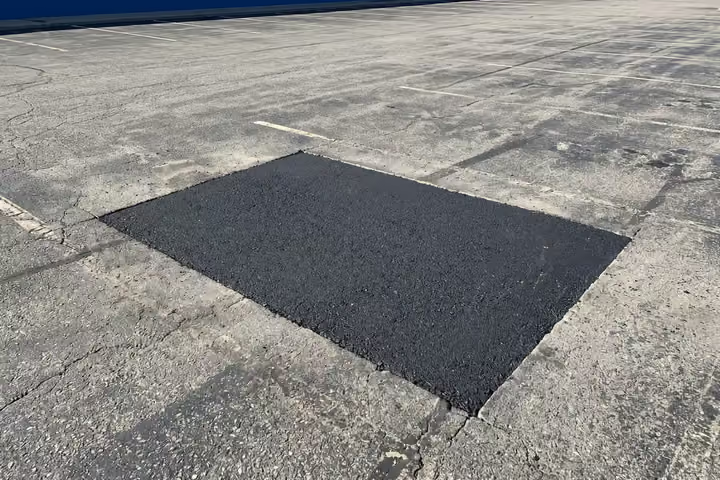
| A patchwork of old repairs | Cold patch left in place, mismatched repairs | Hot asphalt patches cut square and finished flush |
| Spiderweb cracking in one area | The base under that area has failed | Full-depth repair of that area |
| Lines nobody can read | Wear from traffic, plows and salt | Line painting |
Patching and crack filling between full repaves are covered on our parking lot repair page.
Building for trucks
Loaded trailers and turning tractors break down pavement built for cars. A Concord yard rarely carries the same load everywhere: the truck lanes, loading aprons and turning areas need a deeper base and heavier asphalt, while the car parking can be built lighter. Sizing each area to the traffic it actually carries is how a yard avoids paying truck-grade prices for staff parking, or car-grade pavement where trailers turn. See industrial paving for how those builds differ.
Turning is harder on asphalt than driving straight. A trailer pivoting at a dock twists the surface, and a tractor that sits idling in the same spot on a hot afternoon presses into it. Those are the areas to build heaviest, and the ones to check first each spring.
Where a job also involves concrete pads, curbs or drain work, we coordinate the other trades so the sequence on site holds together.
Drainage on large, flat lots
Industrial lots are big and close to flat, which suits trucks but not water. A slope too gentle to see still has to carry every drop to a catch basin. When one area settles even slightly, water collects there, soaks into the base through the first crack, and the next freeze-thaw turns a puddle into a pothole.
On a repave, the slopes across the lot are reshaped so water reaches the catch basins instead of sitting between them. On a repair, the low spot is cut out and rebuilt to the right level. A catch basin whose frame has sunk or whose surrounding asphalt has broken away needs fixing at the same time, or the water keeps finding its way under the new work.
Keeping the site running
Most Concord sites can’t shut for a week, so the work goes in sections, each closed for as short a time as possible while the rest of the site keeps running. A workable plan answers a few questions before the first day:
- Which routes must stay open? Fire routes, the main truck route and access to the docks usually come first.
- Where do people walk? Staff and visitors need a safe, marked route around the work, away from equipment.
- Which stalls matter most? Accessible stalls near the entrance should be moved temporarily, not just closed.
- When is the site quietest? Saturday work can be booked, so a section can close when it causes the least disruption.
Trip hazards and liability
A broken edge where a sidewalk meets the lot, a patch that has dropped a few centimetres, or a pothole in a walking route is a fall waiting to happen. These spots are usually small and cheap to fix compared with the trouble they can cause, and they’re worth putting at the top of the list even when the rest of the lot can wait for next year’s budget.
Planning the budget
Most commercial owners spread paving over several budget years. A sensible order is to fix what’s causing damage now (water getting into the base, trip hazards, failing truck areas), keep the sound areas sound with hot rubber crack filling, and schedule full repaves where the base has gone. Our maintenance programs for property managers cover inspections, patching, hot rubber crack filling, catch basin repair and line repainting on that kind of cycle, and we respond to formal tenders. For per-square-foot figures, see the parking lot cost guide, and for the full range of work, commercial paving.
Our commercial clients include condo boards, plazas, schools and places of worship, along with industrial sites. To get a Concord site priced, contact us with the address, the vehicles that use each area and the hours the site can’t close.