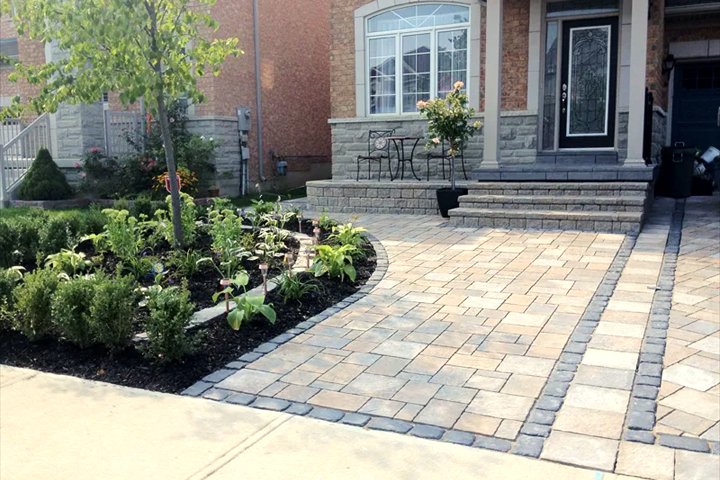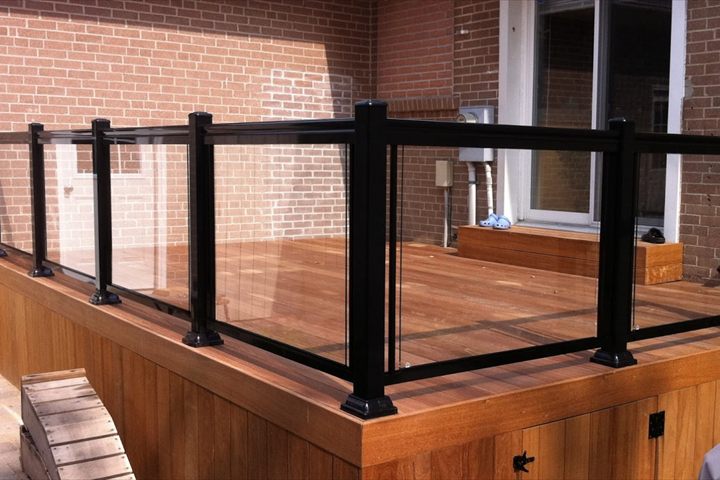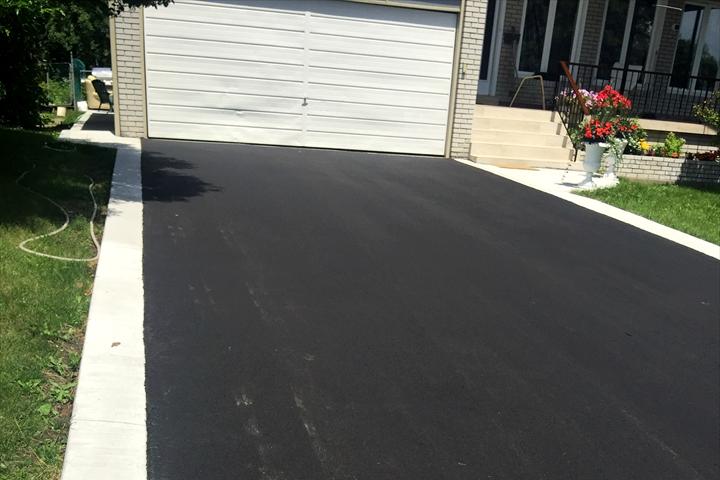
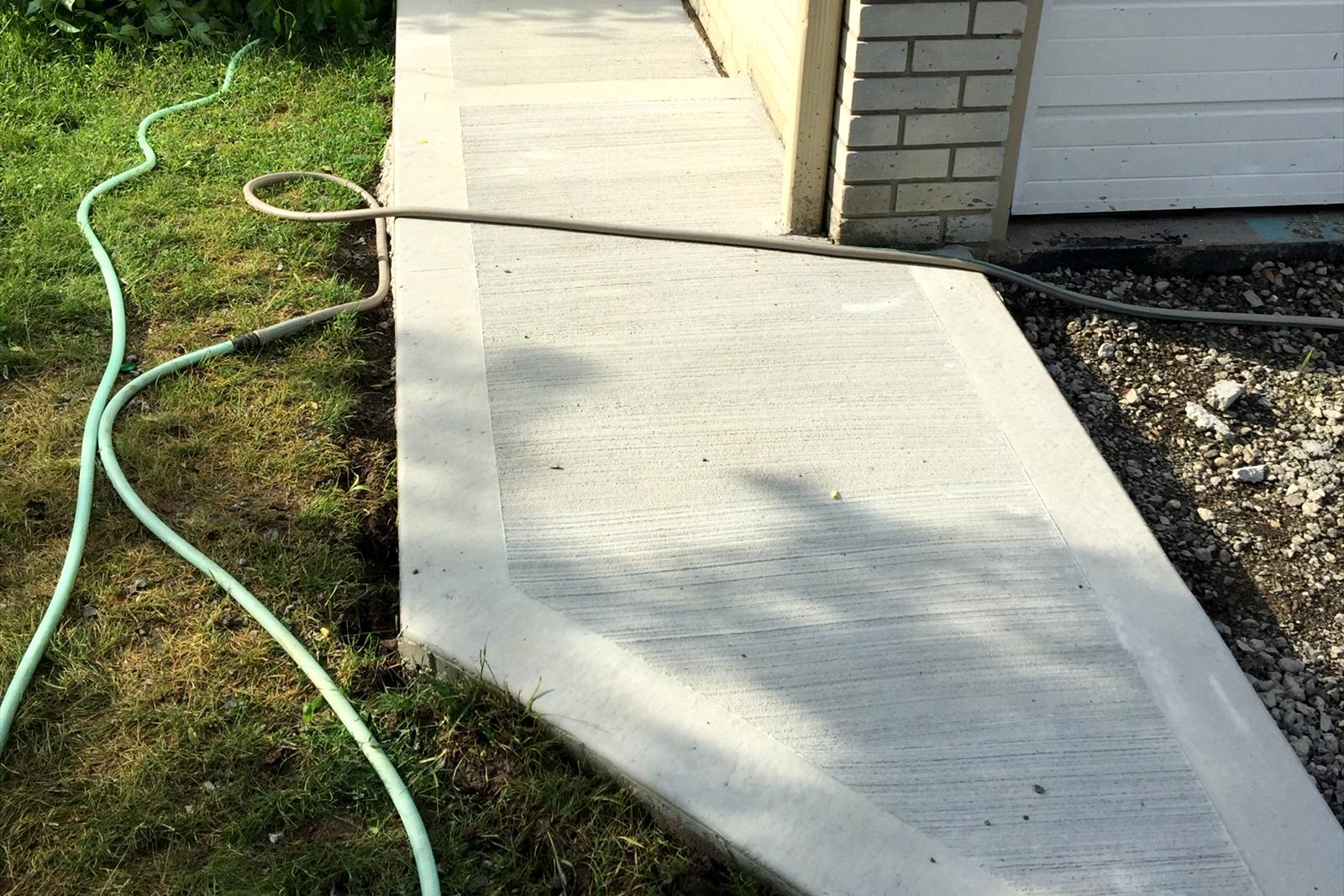
Concrete gets one chance. Asphalt can be milled and repaved, and interlock can be lifted and relaid, but a concrete slab is poured once and what you see a month later is what you have. So the work that matters happens before the truck arrives: the base, the forms, the slope, the reinforcement and where the joints will go.
We pour concrete driveways, walkways, patios, steps, porches and pads for homes across Vaughan, York Region, Toronto and Peel, in a plain or decorative finish, and curbs, sidewalks and pads on commercial sites.
Concrete driveways and walkways
A concrete driveway or walkway is a slab sitting on compacted stone. If the stone settles, the slab is left bridging a gap, and it cracks or tilts. The steps, in order:
- Excavation and base. Topsoil and soft ground come out, and a granular base is placed and compacted so the slab is supported evenly.
- Forms and slope. The forms set the shape, the thickness and the slope. Water has to run off the slab and away from the house, and that is fixed before the pour, not after.
- Reinforcement. Steel in the slab does not stop concrete from cracking. It holds a crack tight so the two sides stay level.
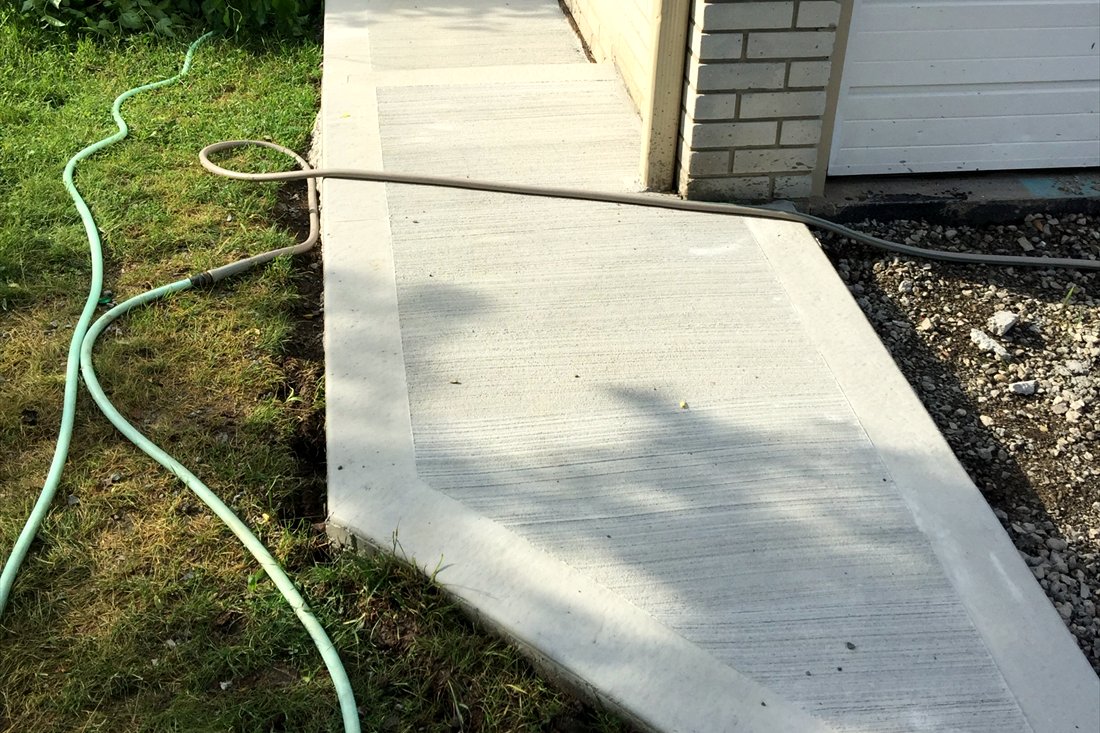
- Pour and finish. For anything you walk or drive on, a broom finish gives the grip you want in rain and snow.
- Control joints. Concrete shrinks as it cures, and it will crack somewhere. Joints cut or tooled into the surface give it a straight line to crack along, out of sight at the bottom of the joint.
- Curing. Concrete gains its strength slowly. We tell you when you can walk on it, when you can drive on it, and when to keep heavy vehicles off.
Steps, porches and pads
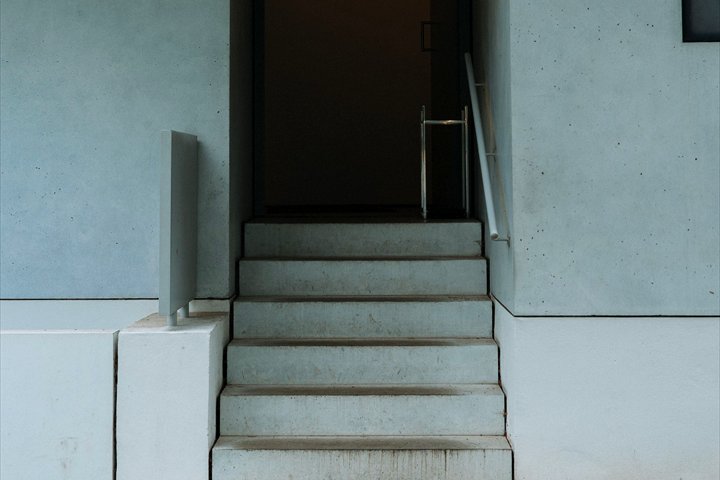
Steps and porches are formed and poured in place, with every riser the same height and a slight fall on each tread so water and ice do not sit on it. Repairing or replacing old steps, building a porch, and planning a railing before the pour are covered on our concrete steps and porches page.
Pads are the simplest concrete there is, and the easiest to get wrong. A garage or shed pad has to be level where the building sits, sloped where water needs to leave, and sized to the structure going on it. Tell us what the pad is for and what it will carry, and it is built for that load.
Decorative finishes
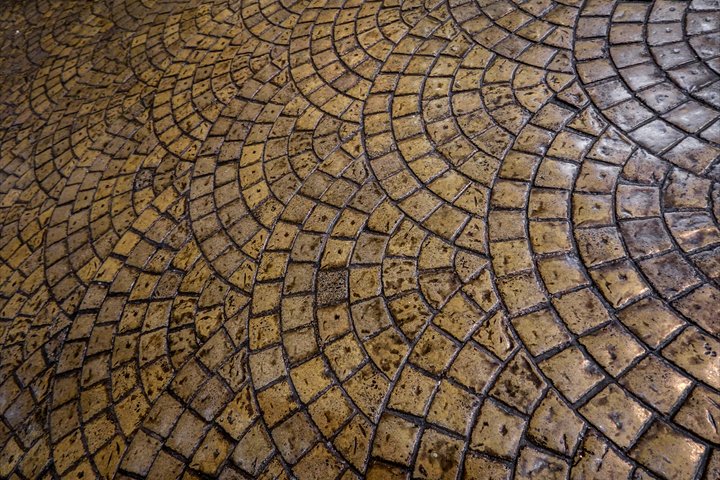
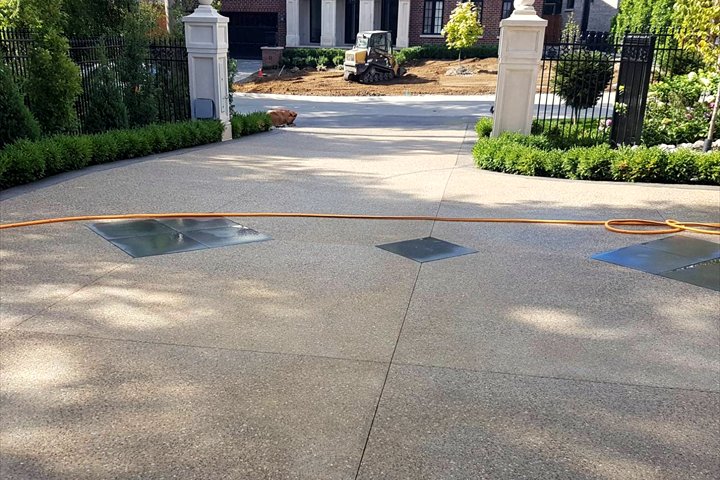
Decorative concrete is the same slab with a different surface. Stamped concrete is pressed with a pattern so it reads as stone, slate or brick. Coloured concrete has colour added to the mix or worked into the surface. Exposed aggregate has the top layer washed away to show the stone, which gives a textured surface with good grip. Each has its own page with how it is built, where it suits and how it holds up.
One thing applies to all of them: a repair to decorative concrete is hard to match, because a new pour never comes out exactly the same shade as an old one.
Concrete patios
A concrete patio is built like a driveway slab with a lighter load: a compacted granular base, forms set to a slope that carries water away from the house, and control joints laid out so the cracks that shrinkage causes fall where you can't see them. The finish is where a patio differs. A broom finish is the most practical, a stamped finish gives the look of stone, and exposed aggregate adds grip around a pool or under a dining table. If a hot tub, an outdoor kitchen or a heavy planter is going on the patio, tell us at the site visit so the slab is built for it.
Concrete curbs, sidewalks and commercial pads
On commercial sites, concrete goes where asphalt is the wrong material: curbs, sidewalks, and pads under loads that sit still, such as garbage bins and trailer legs. A standing load slowly dents asphalt, while concrete carries it without moving.
The order matters when a site needs both. Curbs and pads are poured first, and the asphalt is paved up to them afterwards, so the joint between the two is tight. Because we do the concrete and the commercial paving, that sequence is ours to manage and you are not left scheduling one contractor around another.
Concrete and winter
Road salt and de-icers are harder on concrete than on asphalt. They pull water into the surface, and freeze-thaw cycles then flake the top layer off, which is called scaling. New concrete is most at risk in its first winter. Sand gives traction without the damage, and good drainage matters as much as anything you put on top: concrete that dries between storms lasts far longer than concrete that sits wet.
Concrete or asphalt
We install both. This is how they compare on a driveway.
| Question | Concrete | Asphalt |
|---|---|---|
| Cost to install | Higher. | Lower. Our asphalt price range is published. |
| Look | Light grey, or a stamped, coloured or exposed finish. | One smooth black surface. |
| Loads that sit still | Carries them without denting. | Can dent under a point load in summer heat. |
| Salt and freeze-thaw | The surface can scale. | Handles salt better, and flexes a little with the ground. |
| Repairs | A section is cut out and repoured. The new section shows. | Cut out and patch, or resurface where the base is sound. |
Concrete contractors in Vaughan and the GTA
We are a concrete company with an office in Vaughan, and we pour driveways, steps, walkways, patios and pads in Woodbridge, Maple, Kleinburg, Concord and Thornhill, and across Richmond Hill, Aurora, Newmarket, King City and Markham. We also work in Toronto, Mississauga and Brampton. On commercial sites anywhere in that area, we pour curbs, sidewalks and pads, and pave the asphalt around them.
Before you ask for a quote
Measure the area roughly and take photos of the whole space. Tell us what the concrete is for, what will drive or sit on it, and which finish you have in mind. Note where water goes now. Then send it through the form on this page. The estimate is free and in writing, and it lists the base, the slab thickness, the reinforcement and the finish.