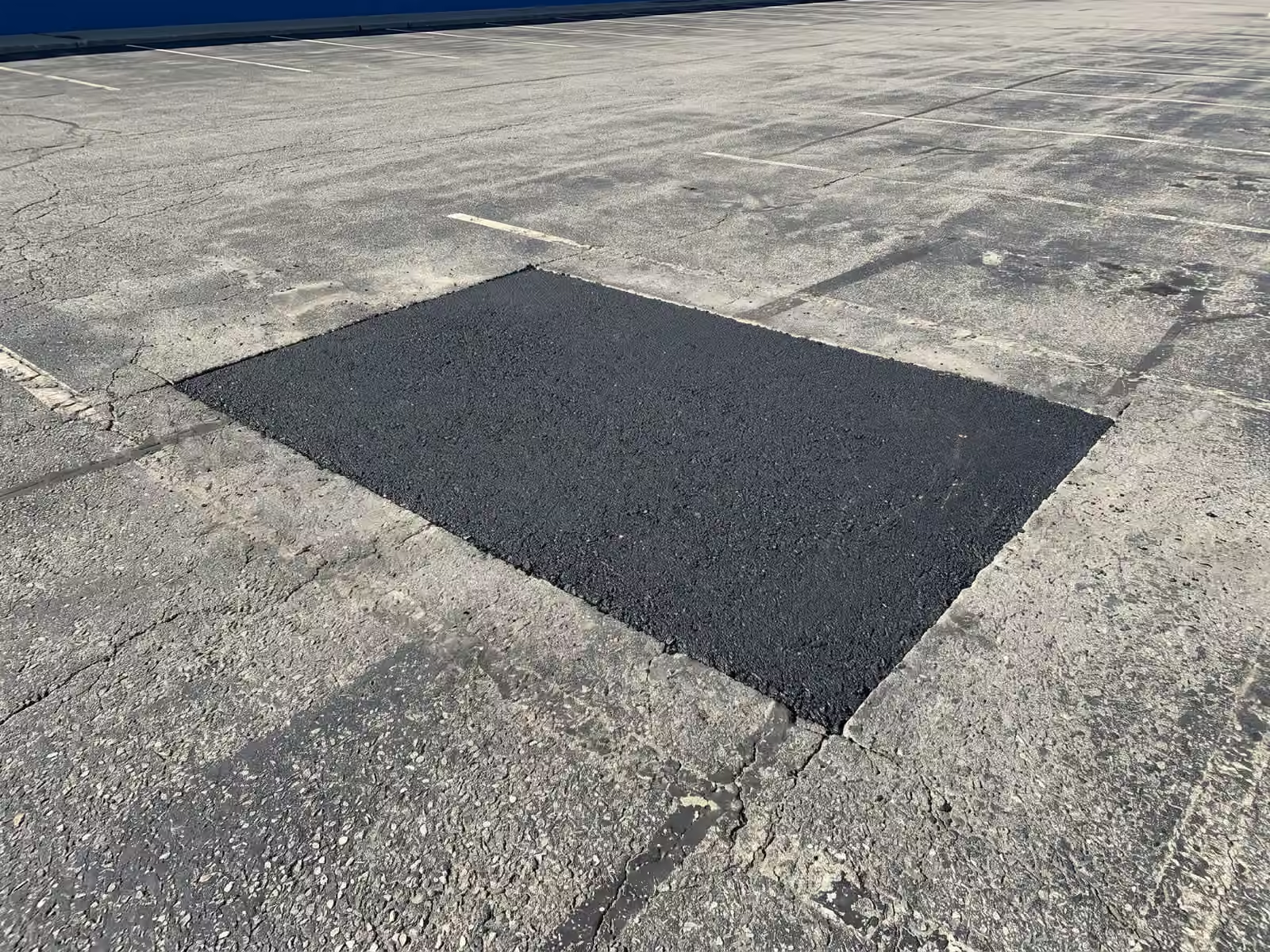
Most lots come out of winter with a few potholes, plenty of cracks, a catch basin that has dropped and a corner where water sits for days. The budget rarely covers all of it at once, so the real question is what to fix first. Sort it by risk: what could hurt someone, then what lets water into the base, then everything else.
Fix it in this order
First: safety and liability
Anything that could trip a pedestrian or damage a vehicle goes to the top of the list. On a commercial property these are also the items most likely to lead to a claim.
- Potholes in walking paths, drive aisles and near entrances.
- Lifted or broken edges at curbs, walkways and transitions to the building.
- Sunken areas around catch basins, where a wheel or a foot can drop.
- Heaved asphalt where tree roots or frost have pushed the surface up.
Ponding near entrances and walkways belongs on this list from November to March, when it freezes into a sheet of ice where people walk. For lots in Aurora, our page on parking lot repair in Aurora looks at the local conditions.
Second: stopping water getting in
Water in the base is what turns a crack into a pothole. Once the hazards are dealt with, the next job is closing off the routes water uses to get under the asphalt.
- Open cracks are cleaned and filled with hot rubber crack filler.
- Ponding areas are assessed to see whether a patch with corrected grades will fix them, or whether the low spot is too large for a repair.
- Joints between old patches and the original asphalt, which open up over time, are filled.
Late summer and early fall are a good time for this work. Water that gets into an open crack in October freezes and expands over the winter, and that is where next spring’s potholes come from.
Third: wear and appearance
Ravelled surfaces, faded areas and small cracks that aren’t yet letting water in come last. These are often cheaper to deal with as part of a larger resurfacing job than one patch at a time.
Repair methods
Cut-and-patch
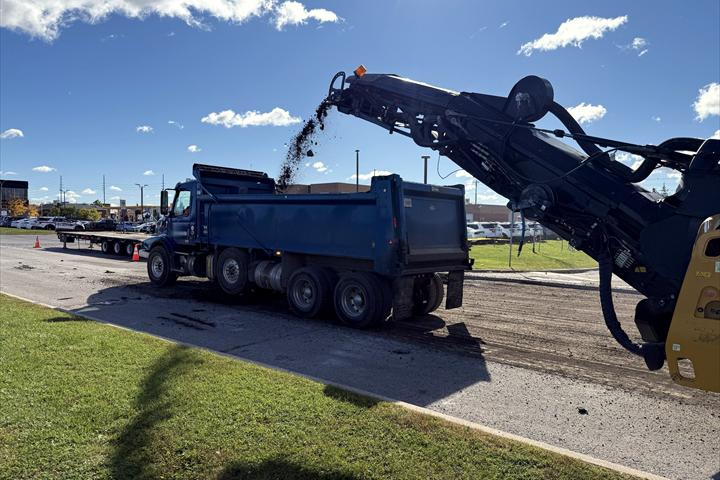
This is our standard repair for potholes and failed areas. A clean rectangle is saw-cut around the damage, a little larger than what you can see, because the base around a pothole is usually weakened too. The broken asphalt and soft base are dug out, new granular base is placed and compacted, and the area is paved with hot-mix asphalt. The straight, vertical edges let the new asphalt bond to the old instead of breaking away.
Simply dropping asphalt into a pothole is quicker, but it rarely survives a winter: the edges are broken, the base below is wet, and the fill has nothing solid to bond to.
Hot rubber crack filling
Cracks are cleaned out and filled with hot rubber crack filler, a material that stays flexible as the pavement expands and contracts and keeps water out of the base. It works on individual cracks. It won’t save an area covered in interconnected cracking, which is a sign the base itself has failed.
Catch basin repairs
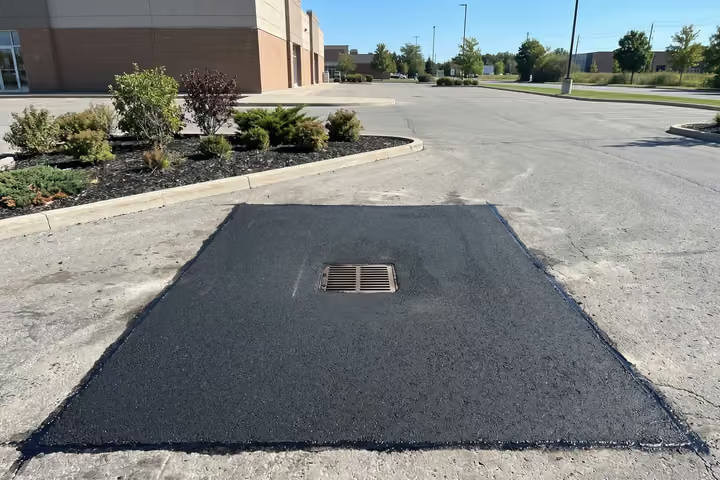
A settled catch basin is a trip hazard and a drainage problem at once, and the asphalt around it is usually repaired in the same visit. Our catch basin repair page explains why patching the dip alone doesn’t last.
The spring walk-through
Spring is when most lots show their damage. Plows catch lifted edges and catch basin frames, salt and constant wet weaken old patches, and a lot that looked fine in November can have new potholes by April.
A spring walk-through is the most useful hour you can spend on a parking lot. Go over the whole lot, mark each defect and sort it into the three priorities above. Our quote is itemized the same way, so you can approve the safety repairs right away and plan the rest. Managers who want this every year can make it part of a maintenance program for property managers.
Ponding and drainage problems
Water that sits on a lot softens the base, turns to ice in winter and becomes a slip hazard near entrances. Ponding usually comes from one of three things, and each needs a different fix:
- A settled area where the base has given way, which can often be fixed with a cut-and-patch at corrected grades.
- A catch basin set too high, or a frame that has lifted, so water can’t reach the grate.
- A lot that was never graded properly, which is a larger fix and usually part of a resurfacing or rebuild.
Working around an open lot
Repairs are usually small enough to do while the lot stays open. A few stalls or one lane are coned off at a time, the work moves through the lot section by section, and each area reopens as soon as the asphalt can take traffic. Entrances stay usable. Repairs along busy storefronts or building entrances can be booked for quieter hours.
When repair isn’t enough
Repair is the right choice when damage is limited to certain areas and the rest of the lot is sound. When cracking covers most of the surface, new patches fail next to old ones or ponding is everywhere, more repair money is mostly wasted. At that point resurfacing or full reconstruction usually costs less over time.
Not sure which side of that line your lot is on? Take photos of the worst areas the day after a heavy rain, when ponding and the spread of cracking are easiest to see, and send them through our contact page.