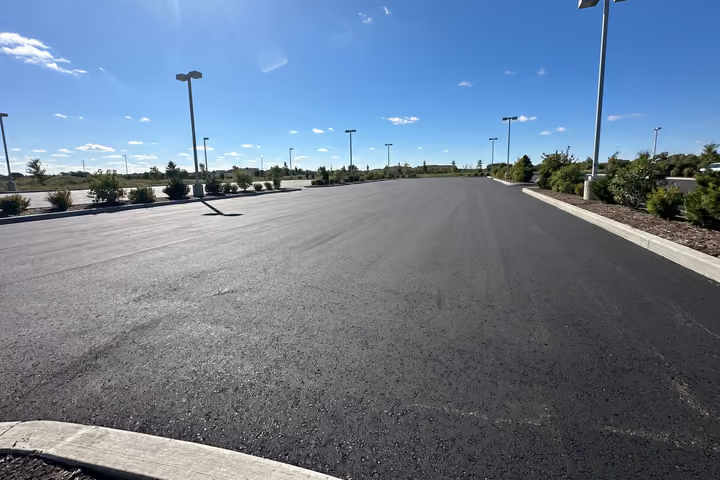
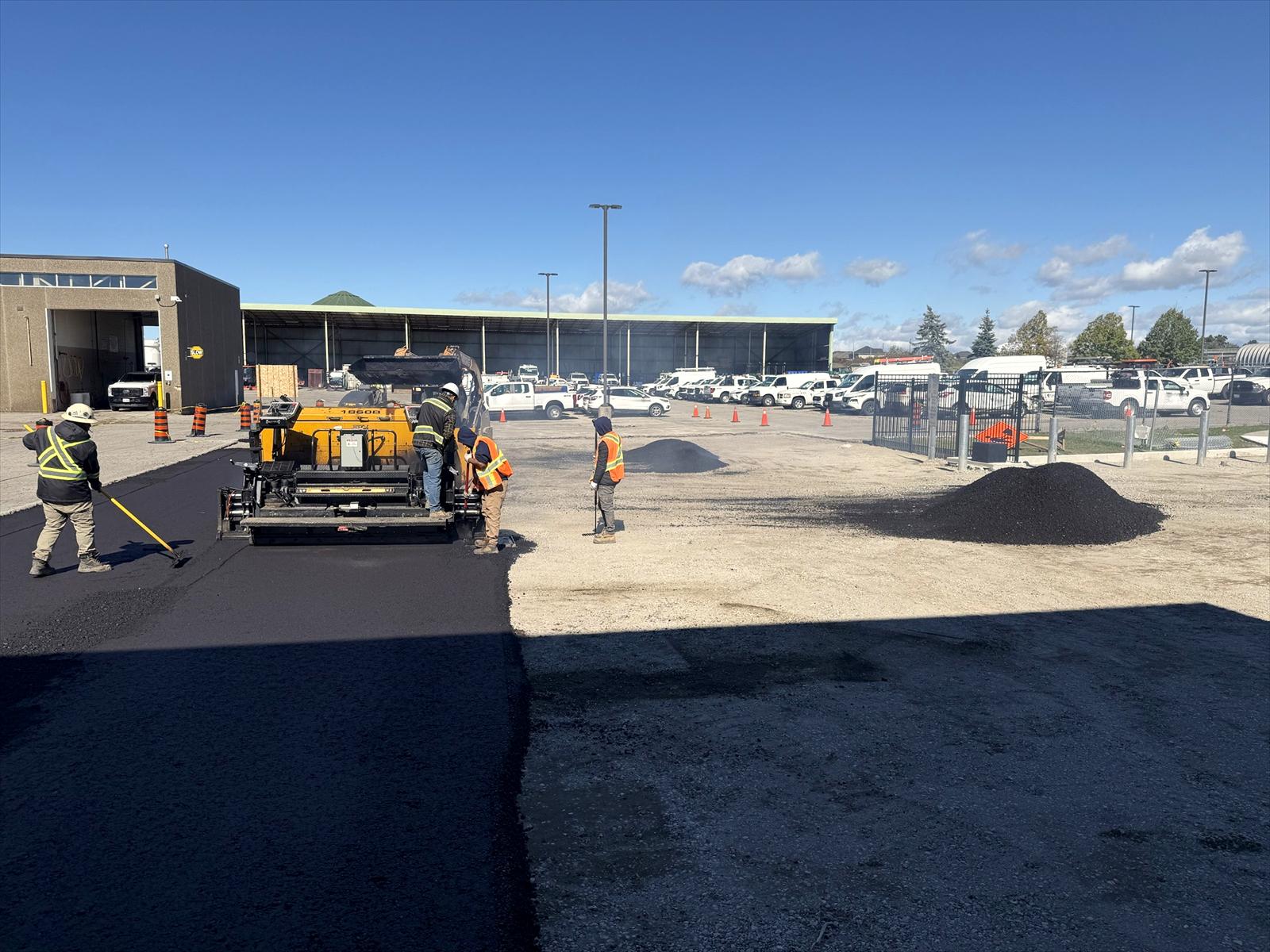
If your lot cracks and sinks in the same places every spring, another layer of asphalt won’t fix it. A parking lot carries cars all day, delivery and garbage trucks every week and plows all winter. What decides how long it lasts is the base under the asphalt. If that base is thin, wet or badly compacted, the surface cracks and sinks however good the mix on top is.
Full reconstruction deals with the cause: the old pavement comes out and the structure is built again from the subgrade up. A new lot is built the same way. If the damage is confined to a few areas, parking lot repair costs far less, and if the surface is worn but the base still holds, resurfacing may be enough.
When a full rebuild is the right call
Reconstruction costs more than resurfacing, so it should be a decision you can defend to an owner or a board. These are the signs to look for:
- Alligator cracking over large areas. Interconnected cracks mean the base below is moving under traffic.
- Ruts in the drive aisles and dips where trucks turn or stop.
- Ponding across many stalls, not one low corner.
- Patches failing faster than they are placed, especially in the same areas each spring.
- A lot that has already been overlaid, where another layer would bury the curbs along with the problem.
When these show up across most of the lot, an overlay usually buys only a few seasons. Taking the lot down to the base and rebuilding it is usually the lower cost over the life of the property.
Paving a new lot
A new lot, or one being added to an existing property, starts with layout and how the lot will be used. Have answers to these before you ask for prices:
- Is there a site plan? If an engineer or architect has drawn one, it sets the stall count, entrances, fire route and grading, and the lot is built to it.
- Does an entrance open onto a busy road? Paving the entrance apron puts trucks and a paver at the street edge, so it is usually planned for a quieter time of day, with traffic control if the road is busy.
- What will use the lot? A lot that only sees cars is built differently from one that also takes delivery trucks, garbage trucks or buses. Truck routes and loading areas may need the heavier section described under industrial paving.
- Where will water go? A new lot may have no catch basins yet. Storm connections and underground piping are a separate contract; the paving grades the lot to the basins and sets their frames to the finished surface.
- What is the ground like? A lot on fill or a former field needs the subgrade prepared before any base goes down.
How a parking lot is built
Excavation
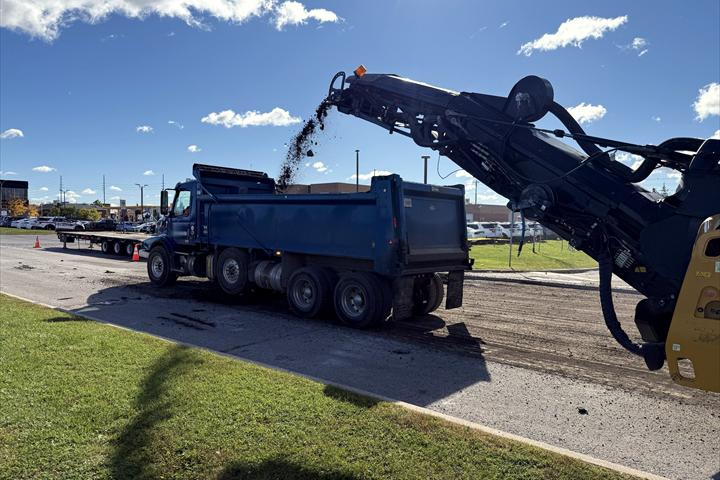
The old asphalt is broken out and hauled away, then the ground is dug to the depth the new base needs. Soft, wet or organic soil found under an old lot is removed, not covered over. Much of the GTA is built on silty, clay-bearing glacial tills that drain slowly and are frost-susceptible, so a soft spot left in place tends to come back as a dip after a winter or two.
Granular base
Crushed stone is placed in layers and compacted. As general practice, commercial lots use a granular subbase with a Granular A layer on top, a crushed stone that locks together and drains. The base is shaped to the finished grades, so water already runs where it should before any asphalt goes down. Your quote should state the depth of each layer; it depends on the soil and the traffic the lot carries.
Binder course
The first asphalt layer is the binder course, commonly an HL8 mix. It has larger stone and gives the lot its strength. On a phased job, sections are sometimes opened to traffic on the binder course before the surface goes down, which keeps more parking available.
Surface course
The top layer, commonly HL3, is finer than the binder course and gives a smooth, tight surface that sheds water and looks finished. It is placed and rolled hot, so it compacts fully and bonds to the binder below.
Drainage, catch basins and grading
Water is the main reason parking lots fail, so every lot needs a plan for where rain and meltwater go, built into the grades.
- Grading. The surface slopes so water runs to catch basins or off the site, away from stalls and building entrances.
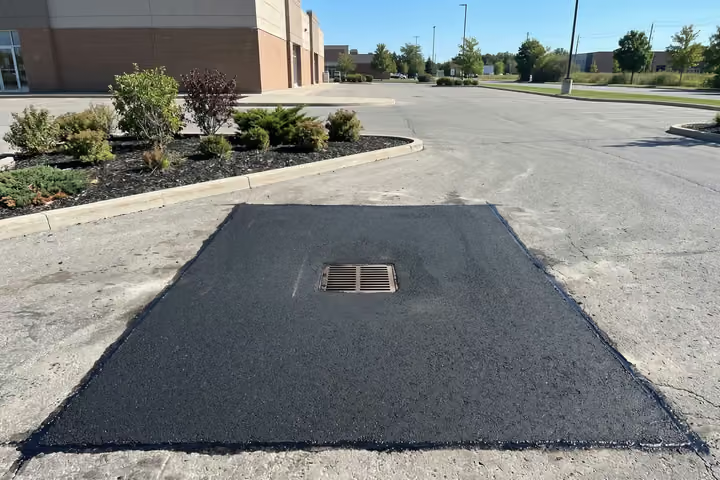
- Catch basins. Basins that have settled or have broken frames are rebuilt and set to the new finished grade, so water drops in instead of pooling around them. Our catch basin repair page explains why patching around a failing basin doesn’t hold.
- Low spots. Areas that have held water for years are corrected in the base, not topped up with extra asphalt.
- Edges and curbs. Asphalt meets curbs at the right height, so water follows the gutter line to the basins.
If an engineer’s grading plan exists, the lot is built to it. If not, walk the lot during a heavy rain before the job starts and note where water sits and where it comes from. Those are the spots the new grades have to fix.
Keeping the property open
A plaza can’t close its parking for two weeks, and a condo can’t block residents from their cars. A rebuild on an occupied site is done in sections:
- The lot is divided, usually along drive aisles, so each section can close while the others stay open.
- At least one entrance stays usable, and the fire route stays clear at every stage.
- Accessible stalls in a closed section are moved temporarily and signed.
- Some sections can be scheduled for a Saturday or an evening.
Agree the order of sections and their dates before the work starts, so tenants or residents get proper notice.
After paving: line painting
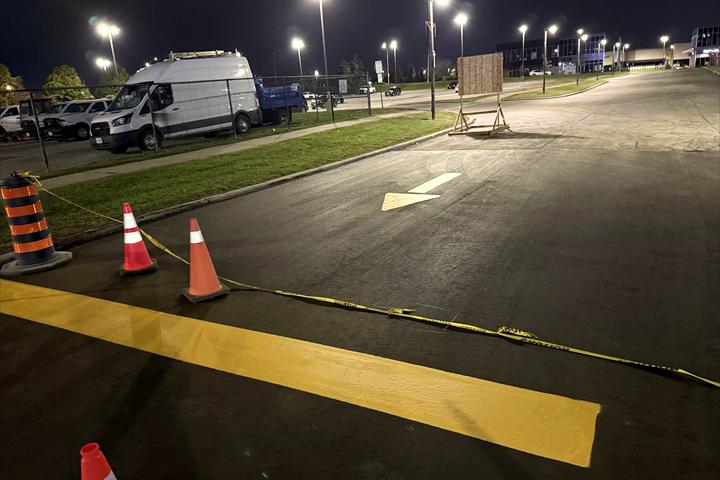
A new lot isn’t usable until it is marked. Stall lines, fire routes, accessible stalls, arrows and crosswalks are painted once the surface course has firmed up. A rebuild is also the best moment to fix a layout that never worked, as our line painting page explains.
Cost
Our 2026 range for parking lot paving is $3.50 to $5.00 per square foot, depending on the location and complexity of the job. The parking lot cost guide explains what moves a job within that range and works through three lot sizes.
Planning a rebuild
Send a site plan or aerial photo with the problem areas marked through our contact page, and tell us two things: whether the property has a site plan or grading plan, and how many entrances the lot has. Those answers shape how the work is split into sections more than anything else on a rebuild. For local detail, see parking lot paving in Newmarket and parking lot repair in Aurora.