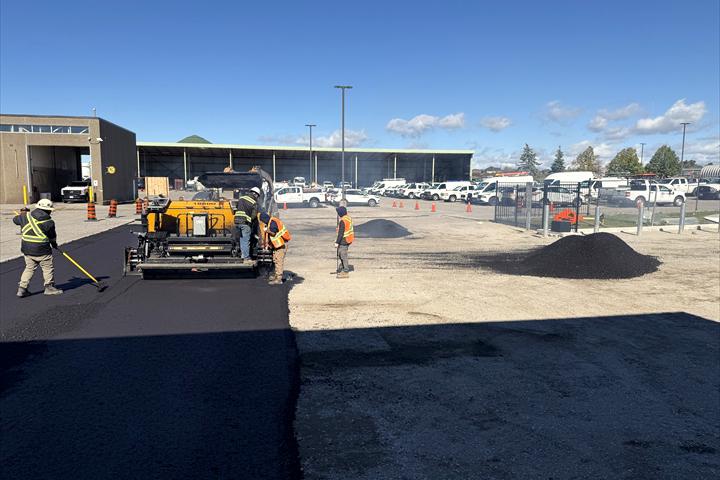
Start with the heaviest vehicle on the site. Warehouses, distribution centres, truck yards and manufacturing sites carry tractor-trailers, straight trucks, forklifts crossing between buildings and staff cars, all on the same pavement. A structure that would last for years in a plaza lot can rut and break up in a season under loaded trucks. So industrial paving begins with how the site is used, not with a standard spec.
We work on industrial sites across the GTA, including the industrial areas of Concord, close to our Vaughan office, and Brampton.
Where industrial pavement fails
Industrial sites fail in predictable places. Walk your site and look at these first:
- Truck turning areas. Tight turns twist the asphalt under the tires, shoving and tearing the surface. Corners near the entrance and at the end of drive lanes take the worst of it.
- Loading dock aprons. Trucks stop, reverse and sit at the docks. Braking, starting and standing loads in one spot cause ruts and depressions in front of each door.
- Trailer parking. Dropped trailers rest on dolly legs that press into the surface, especially in summer heat.
- Entrances. Every truck crosses the entrance, so the base here carries the full traffic of the site.
- Drive lanes along buildings. Trucks follow the same line every day, wearing ruts into the wheel paths.
- Drainage points. Catch basins in truck areas are hit over and over and settle, and a sunken basin in a truck lane soon becomes a pothole around a grate.
Heavier structures
As general practice, industrial areas are built with a thicker structure than a car parking lot:
- Deeper granular base, compacted in layers, to spread the load over weak subgrade.
- Thicker asphalt, often with more binder course and sometimes more than one binder lift before the surface course.
- Stronger edges and transitions where pavement meets dock aprons, concrete pads or building slabs.
On the slow-draining, frost-susceptible glacial tills common across the GTA, a wet subgrade under truck loads is the fastest route to failure. Soft areas are dug out and replaced, not paved over.
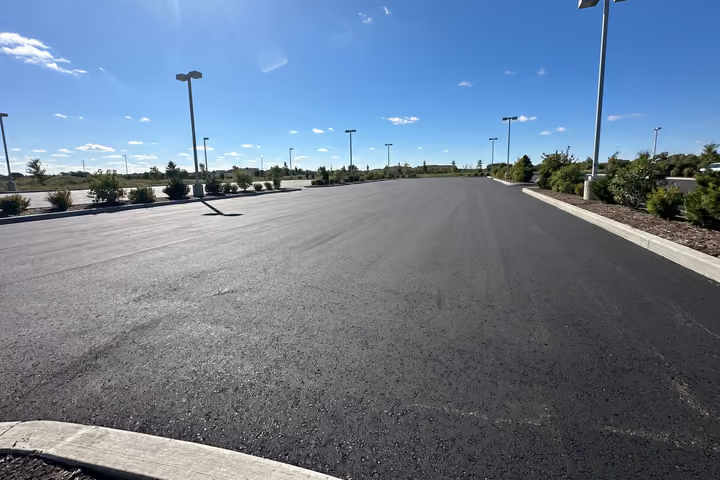
Not every part of a site needs the heavy structure. Staff parking and visitor areas can be built like a standard parking lot, with heavier sections only where trucks run, turn and park. That keeps the cost where it is needed. A good quote breaks out the depths area by area, so you can see where the heavier section is being paid for.
Loading docks
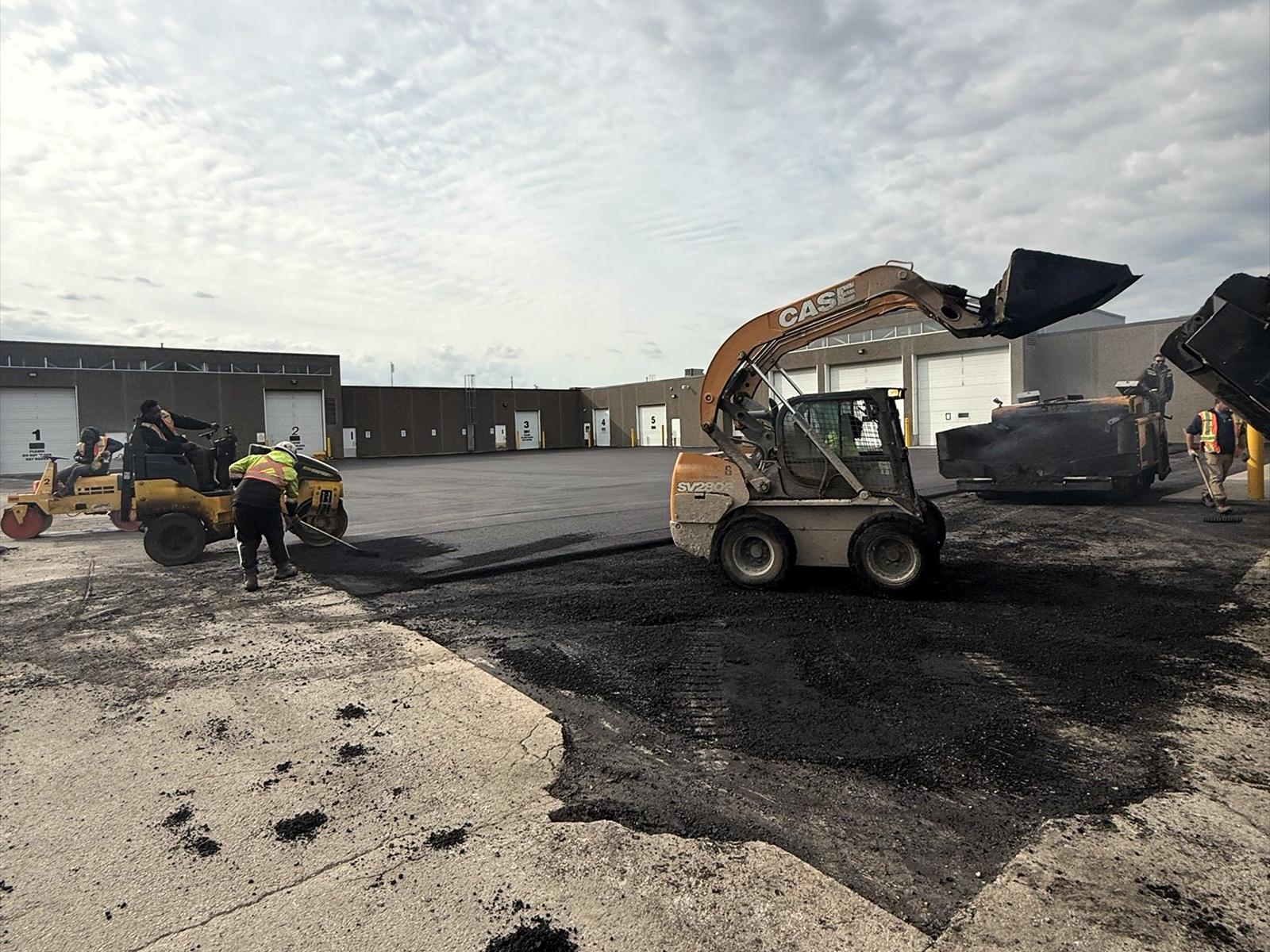
Docks are the hardest-working part of most industrial sites. The asphalt in front of a dock door takes repeated braking, reversing and standing loads, and often has drainage trouble where the apron slopes down toward the building.
At the docks, look at:
- The apron slope and drainage, so water doesn’t sit at the door or run under the dock.
- Trench drains or catch basins at the bottom of depressed docks, which need to sit at the right height.
- The joint between asphalt and any concrete apron, which opens up over time and lets water in.
- Rutting in front of each door, which can be cut out and rebuilt one dock at a time.
We pour concrete pads as well as paving. Where pads or aprons are part of the design, the concrete goes in first and the asphalt is paved up to it.
Keeping the site operating
Industrial sites rarely shut down for paving. Shipping and receiving keep running, trucks still need to reach the docks, and staff still need to park. So the work is split around operations:
- Sections by function. Truck routes, dock areas and staff parking are done separately.
- A truck route always open. One way in and out for trucks stays usable at every stage, as do fire routes.
- Dock-by-dock work. Where a full closure isn’t possible, docks are done in groups while the others stay in use.
- Your shipping calendar. Tell us your peak periods and heavy days when you ask for a quote, so the sections can be timed around them.
When a weekday closure would hit shipping too hard, a Saturday section is usually the alternative; plan it around your receiving days.
Repairs between rebuilds
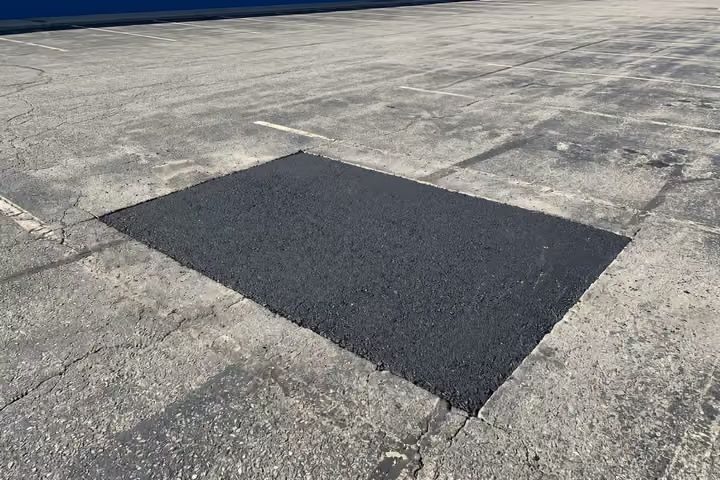
Most industrial sites don’t need full reconstruction every time something fails. Rutted turning areas, failed dock aprons and potholes along truck routes can be cut out and rebuilt with a heavier structure, and cracks can be filled with hot rubber crack filler to keep water out, using the same methods as parking lot repair.
For a quote, describe a normal day on the site: roughly how many trucks, what kind, where they turn and where trailers are dropped. Send that with a site plan or aerial photo through our contact page. If you don’t have truck counts, a description is a good start.