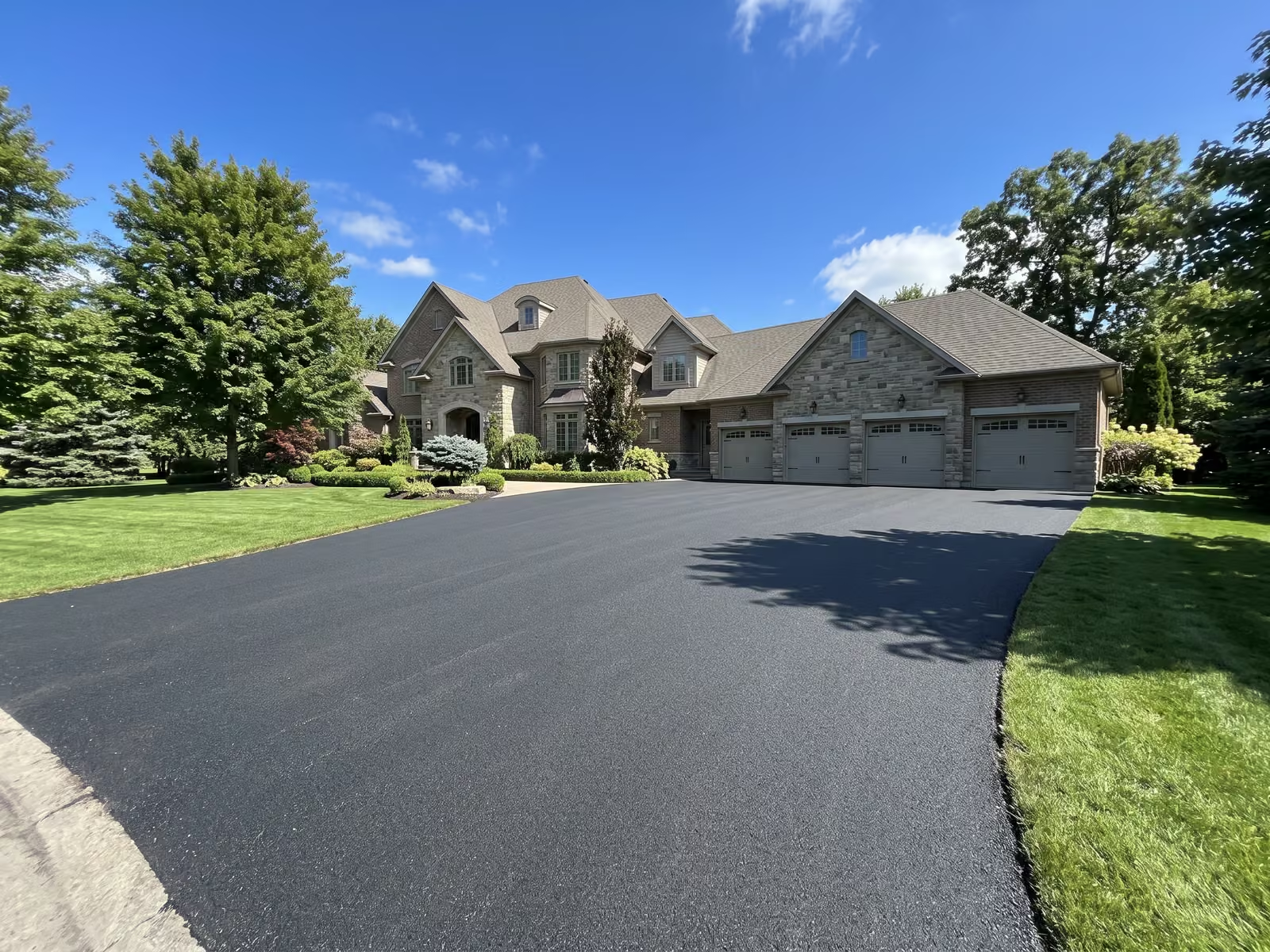
We will resurface a driveway, and we usually advise against it. The reason is the bond. A new layer of hot-mix laid over old asphalt never fuses with it the way two fresh lifts placed on the same day do, and a tack coat does not change that on its own. What carries the load is thickness, and below roughly 1.5 to 2 inches the new layer has too little mass to stay where it was put. Most driveways cannot take that much extra height before the asphalt sits level with the garage slab, so most driveways are poor candidates.
That is the short answer. The rest of this page is how to tell whether yours is one of the exceptions.
Why thickness decides it
Two lifts of asphalt placed hot, one after the other, knit together as they cool and behave as a single slab. An overlay is a different situation: cold, cured, oxidized asphalt underneath, and a new layer on top. A tack coat such as SS-1 emulsion is sprayed between them so the surfaces grip, and it does help, but it is an adhesive between two layers rather than a weld joining them into one.
That leaves the new layer carrying its own loads. Cars turning their wheels while stationary put a surprising amount of shear into a driveway surface, and summer heat softens asphalt while frost lifts it from below. A layer with real depth absorbs that. A thin skim has nothing to absorb it with, so it ravels, lifts at the edges, or slides in the wheel path. Somewhere around 1.5 to 2 inches of compacted asphalt is where a resurface stops being a cosmetic patch and starts behaving like a surface course.
A resurface thinner than that is mostly cosmetic.
Where the height has to come from
The catch is that 1.5 to 2 inches has to go somewhere. Asphalt added on top raises the finished level by its full thickness, and driveways are usually hemmed in:
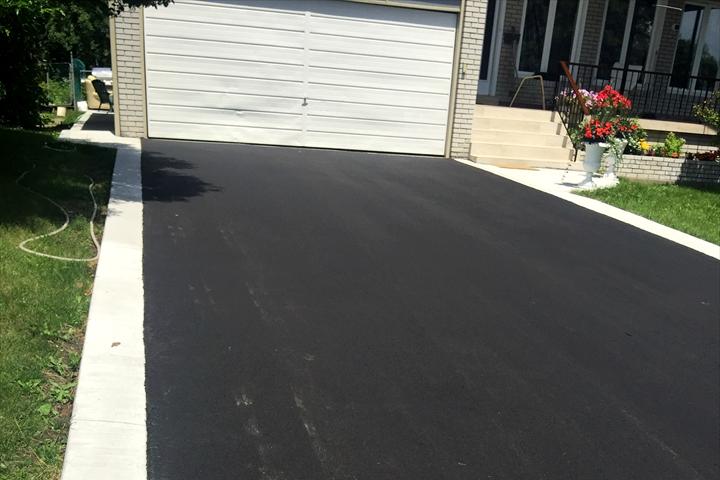
- The garage slab. If the asphalt already meets the slab, raising it pushes water into the garage instead of away from it.
- The front walkway and steps. A raised driveway leaves a lip or an awkward short step at the junction.
- The curb. Less curb showing means less of a barrier keeping road runoff in the gutter rather than spilling onto the driveway.
- Earlier overlays. A driveway already carrying one or two layers has usually spent whatever room it had.
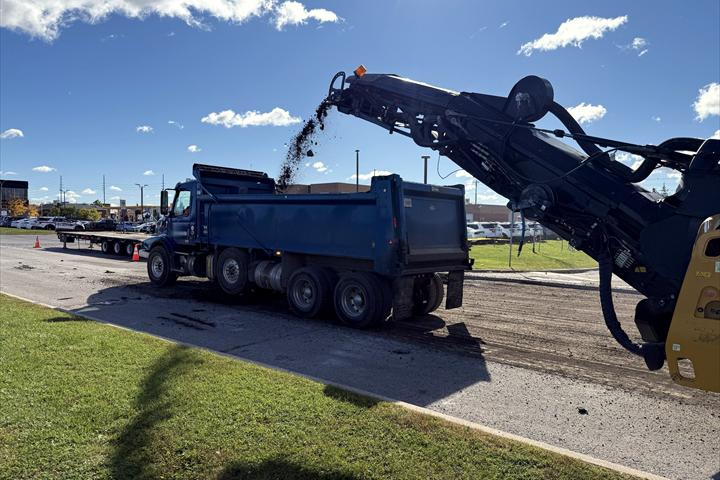
Where there is no room, the old surface can be milled off first and a proper layer paved back in its place. The finished height stays close to today’s, which solves the problem, but milling and hauling the old material away add cost. At that point the saving against a full replacement has narrowed, and a replacement rebuilds the base as well.
When resurfacing is worth doing
It becomes a reasonable choice when all of these hold:
- There is room for a full 1.5 to 2 inches, or the driveway can be milled to make room.
- The driveway holds its shape. No dips, ruts or soft areas underfoot.
- Water runs off instead of pooling.
- Cracks are narrow and separate, not joined into a web.
- The edges are supported and not crumbling into the lawn.
- Any earlier repairs have held.
A driveway that ticks every one of those is getting a new wearing surface over a structure that is still doing its job, and that can last for many years.
When it will not last
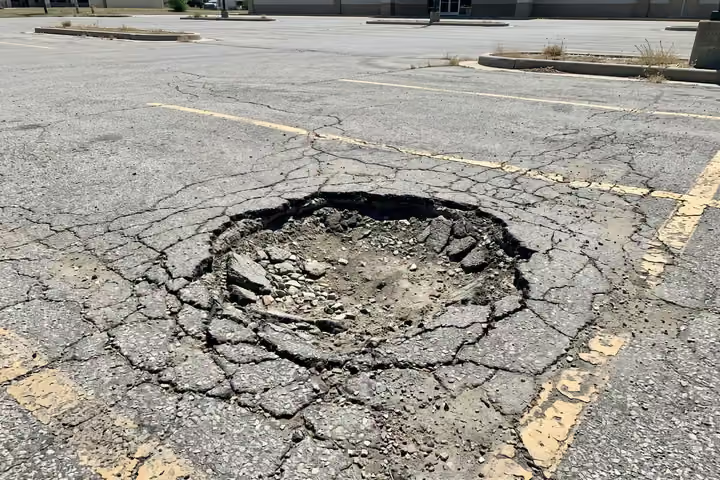
The base has gone. Asphalt moves with whatever is under it. A soft, wet or broken base pushes the old crack pattern back through the new surface, often inside two winters. The silty, clay-bearing glacial tills across much of the GTA drain slowly and are frost-susceptible, and parts of the Oak Ridges Moraine sit on a high water table. A new layer covers that water, it does not remove it. Small areas can be cut out and rebuilt first; widespread failure cannot.
Water is already going the wrong way. A new layer follows the shape of the old one. A low spot that ponds now will pond again at the new level. Correcting a grade means milling deeper or rebuilding that section.
The edges are breaking up. An overlay laid over a crumbling edge has nothing holding it at the side, which is exactly where water gets in. Edges have to be rebuilt first.
What we suggest instead, most of the time
If a handful of areas are bad and the rest is sound, asphalt repair and hot rubber crack filling will keep water out of the base for a fraction of the cost, and buy time to plan properly.
If the surface is tired across the whole driveway, or the base is suspect, a full driveway replacement removes the old asphalt, rebuilds the base and pays back over a far longer life. The driveway cost guide sets out the ranges.
Commercial lots work differently. There is usually more room for height, the areas are larger, and milling is routine, which makes resurfacing a more common answer there. See parking lot resurfacing.
Getting an answer on your driveway
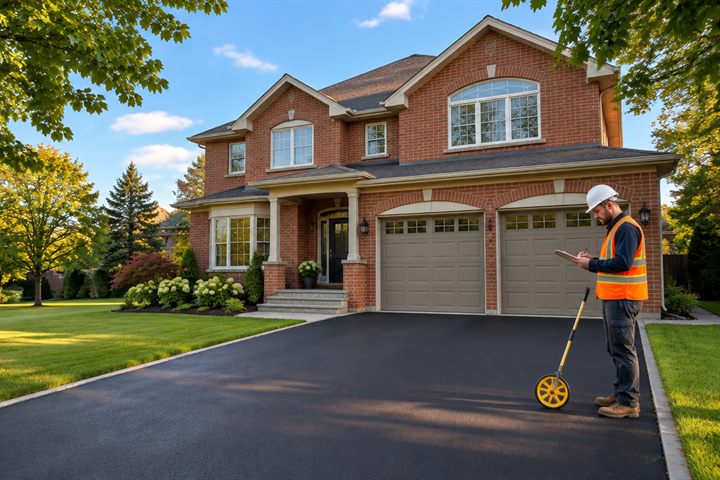
We don’t publish resurfacing prices, because the figure depends on how much repair comes first and whether milling is needed. Send three photos through our contact page: the driveway from the street, the worst of the cracking close up, and the garage door showing how far the slab sits above the asphalt. That last one usually settles it, because it shows whether a layer thick enough to last would fit.