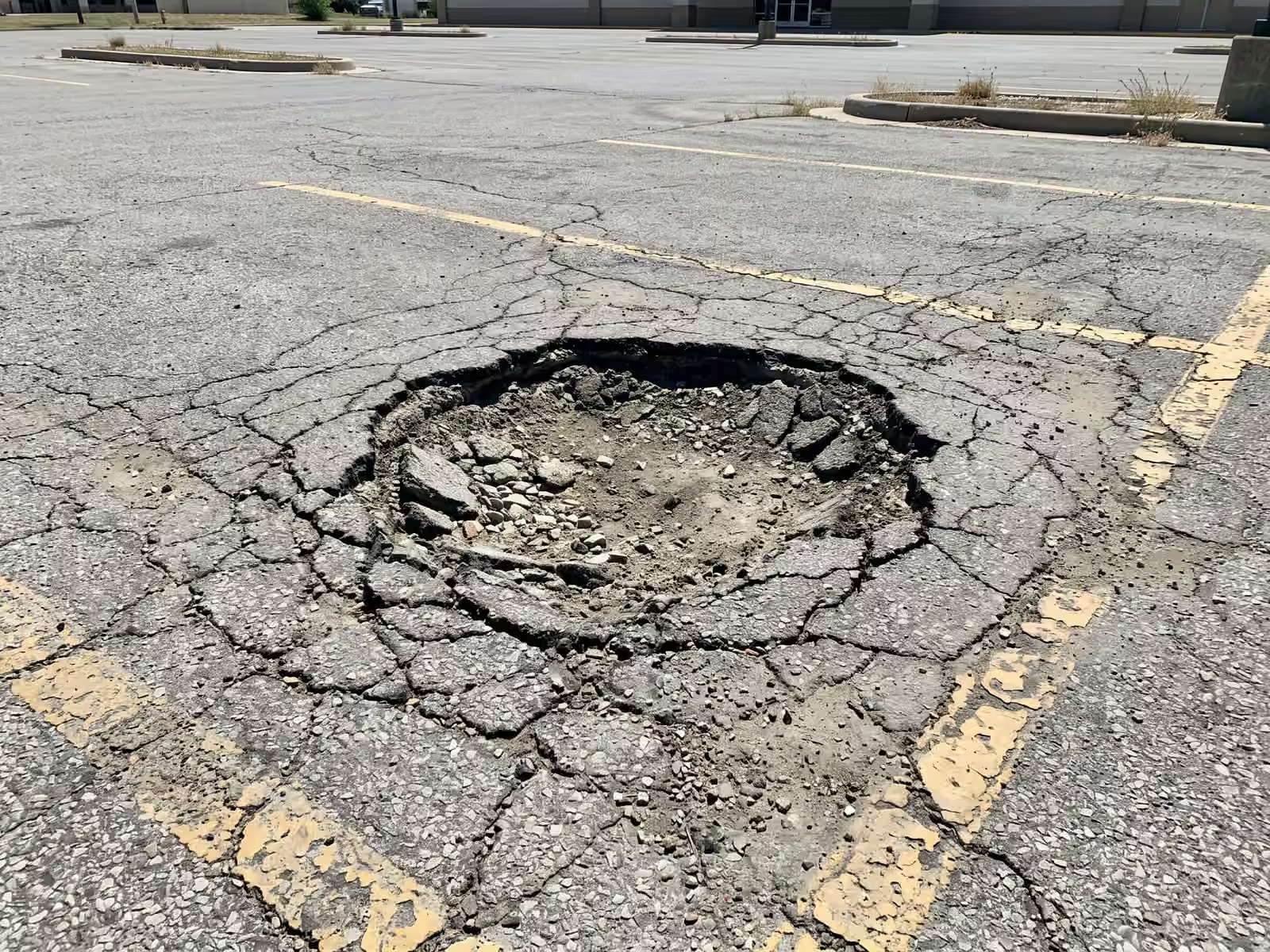
Good asphalt repair stops water. Almost every pothole, crack and sunken corner on a driveway starts with water reaching the stone base, softening it, and then freezing. A repair that only fills the hole on top leaves that problem in place. So the first question for any repair is where the water is getting in, and the right repair is the one that stops it.
The repairs below are for driveways. Parking lots carry heavier, constant traffic and are handled under parking lot repair.
Pothole repair
A pothole forms when a crack lets water into the base, the base softens, and traffic breaks the weakened asphalt away. By the time you see a hole, the stone underneath is usually loose or wet.
We repair potholes as cut-out patches: square up the hole, remove the broken asphalt and loose material, recompact or replace the base, then fill with hot-mix asphalt and roll it flat. A bag of cold patch from a hardware store can make a hole safe for a while, but it is a stopgap and usually works loose.
Patching: cut-out or surface patch
Cut-out and replace
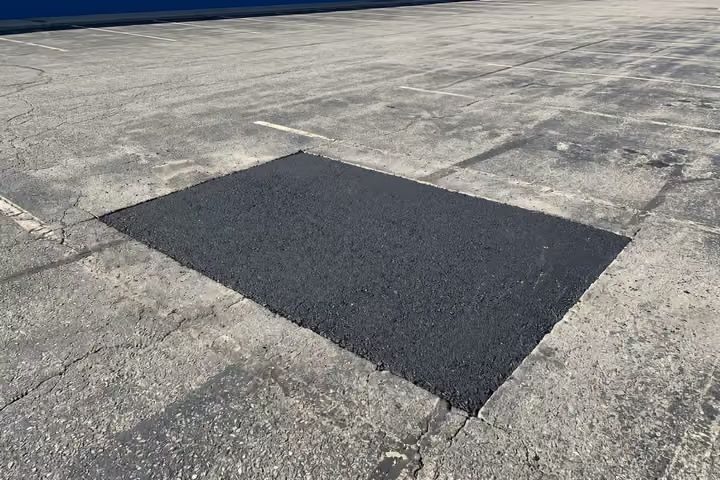
The damaged area is saw-cut into a clean rectangle a little beyond the visible damage. The asphalt inside is removed, soft base is dug out and replaced with compacted stone, the cut edges are coated so the new mix bonds, and hot asphalt is placed and rolled level with the surrounding surface.
This is the repair that lasts, because it fixes the base as well as the surface. It costs more than a surface patch and takes longer, but it is the right choice for potholes, alligator cracking in one area, and anywhere the asphalt flexes underfoot.
Surface patch
A surface patch is a thin layer of hot asphalt placed over a worn or ravelled area without digging out the base. It is quicker and cheaper.
It only lasts when the base underneath is sound and the problem is the surface itself: a shallow worn spot, loose stones on top, or a small depression with no cracking. Placed over a soft base, a surface patch cracks along its edges and lifts, often within a winter. Before you accept a surface patch, press on the area with your heel or watch it when a car rolls over: if the asphalt flexes, the base is the problem and only a cut-out patch will hold.
Hot rubber crack filling
Hot rubber crack filling uses a rubberized filler heated until it flows. Cracks are cleaned out first so the filler can stick to the sides, then the hot material is poured in. As it cools it stays flexible, so it can stretch and shrink with the asphalt through the seasons instead of popping out.
It helps when:
- Cracks are narrow and separate, not joined into a web.
- The asphalt on both sides of the crack is level and firm.
- The driveway is otherwise in fair shape and you want to keep water out of the base.
It won’t fix:
- Wide, open cracks where the edges have broken down or the two sides sit at different heights. These usually need a cut-out patch.
- Alligator cracking, the pattern of small connected blocks. That means the base below has failed.
- Cracks over a sinking area. Filling them closes the gap on top, but the ground keeps moving.
Crack filling is a maintenance step, and it pays most when done early, while a crack is still a single line. Once cracks join up, water has had years to work on the base.
Edge repair
Driveway edges break off where the asphalt was laid past the end of its stone base, where tires run off onto the lawn, or where snow plows catch them. A crumbling edge lets water into the side of the base, and the damage creeps inward.
We cut back to sound asphalt, rebuild and compact the base out to the edge, repave the strip, and shape the edge so it is supported instead of hanging over soil. If the edge keeps getting driven on, it may make sense to widen that side properly. See driveway widening and extensions.
Sunken areas at the curb or garage
Two spots sink more than anywhere else on a driveway.
- At the curb, a dip often follows an old utility trench that was never fully compacted, or water running off the road. Plow blades and road salt work on this strip every winter, which speeds up the damage once a dip forms.
- At the garage, settling is usually caused by water from downspouts or a slope that runs toward the door, softening the base right where it is hardest to drain.
The repair starts the same way in both places: cut out the sunken section, dig out the soft material, rebuild the base with the right slope so water runs away, and repave. Filling the low spot with extra asphalt on top doesn’t work for long, because the ground under it is still soft. What differs is the cause. At the garage, a downspout emptying onto the driveway will soften the new base just as it did the old one, so it needs redirecting too. At the curb, if the low strip runs the full width and the rest of the driveway is also tired, replacing the driveway may make more sense than patching one end.
Repair, resurface or replace
Use this as a rough guide. We confirm it on a site visit.
| What you see | Usually the right fix |
|---|---|
| A few narrow cracks, firm surface | Hot rubber crack filling |
| One or two potholes or damaged areas, rest of the driveway solid | Cut-out patching |
| Worn, faded or rough surface over a firm base, with only minor cracks and height to spare | Resurfacing |
| Alligator cracking over large areas, widespread sinking, water pooling in many places | Full replacement |
| Patches on top of patches, each failing faster | Full replacement |
A simple rule: if the damage covers a small part of the driveway, repair it. If the surface is tired but the base is sound and there is height for a full layer, resurfacing is worth pricing. If the base has failed across much of the driveway, repairs will keep failing and replacement is the better value. The cost guide explains what a replacement costs.
Before you ask for a repair quote
Walk the driveway after a good rain. Note where water sits, which cracks stay dark and wet longest, and whether the low spots line up with downspouts or the street. Those are the places the base is taking on water, and they are what a repair has to deal with. Send photos of them through our contact page for a free written estimate that lists each repair, its method and its area.