Stamped concrete is a poured slab pressed with a pattern while it is still soft, so the finished surface looks like slate, stone, brick or wood planks. It is a common choice for a stamped concrete patio, a front walkway or a stamped concrete driveway, because it gives the look of pavers in one solid piece. Underneath the pattern it is ordinary concrete, and it only lasts as long as the base under it.
We pour stamped concrete for homes in Vaughan and across York Region, Toronto and Peel. For other slabs, steps and commercial work, see our concrete page.
What stamped concrete is
Three things make a stamped surface. The base colour is mixed through the whole load, or spread over the fresh surface as a colour hardener and floated in. The texture comes from heavy rubber mats pressed into the concrete. The accent comes from a release agent, a tinted powder or liquid that stops the mats sticking and stays in the low spots, giving the grout lines their darker, weathered look.
Because the pattern is pressed into one slab, there are no real joints between the "stones". That is the main difference from interlock, where every paver is a separate piece that can shift, and be lifted, on its own.
How stamped concrete is built
The first half of the job is the same as any slab. The second half is about timing.
- Base. Soft ground is dug out and replaced with compacted granular stone. A pattern can disguise a lot, but not a slab that has settled.
- Forms and slope. The forms set the shape and a fall away from the house. Curves, borders and step locations are decided here.
- Reinforcement. Steel keeps any crack that forms tight and level.
- Pour and colour. The concrete is placed, levelled and floated. A colour hardener, if used, is broadcast and worked in now.
- Release and stamping. The release goes down, then the mats are laid in sequence and pressed in, with the pattern lined up from mat to mat. Edges the large mats can't reach are textured with flexible mats and hand tools.
- Control joints. Where the pattern allows, joints follow its grout lines, so the line the slab cracks along looks like part of the design.
- Clean-up. Once the concrete has hardened, the loose release is washed off, leaving the accent in the recesses.
Stamping has a window. Press too early and the pattern slumps; too late and the texture comes out shallow and patchy. Sun, wind and temperature move that window by the hour, so each pour is sized to what can be stamped at the right stage. On a large driveway that can mean more hands on the job, or pouring in sections.
Stamped concrete patios, walkways and driveways
Patios. Here the surface is seen up close and walked on barefoot, so pattern and colour count most. Decide where planting beds, a grill station or a hot tub will go before the forms are set.
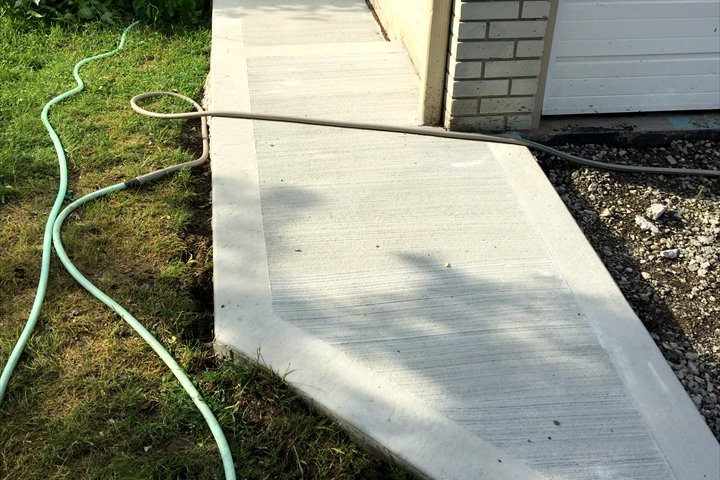
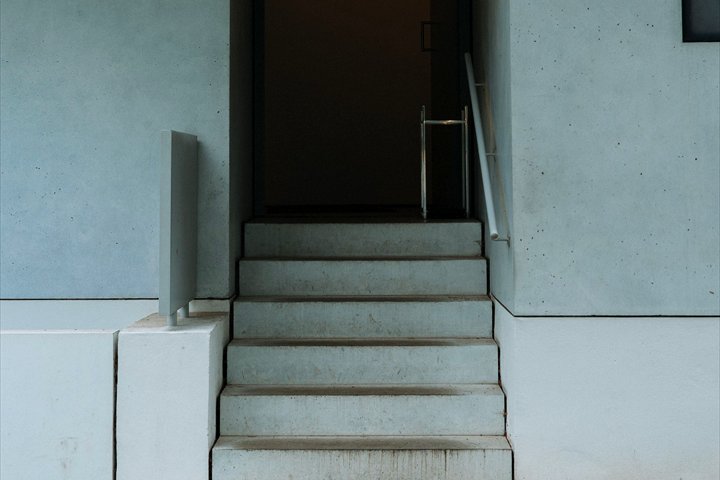
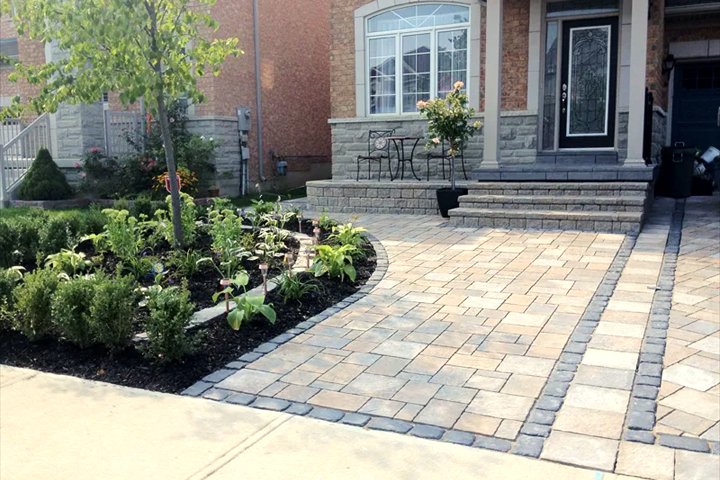
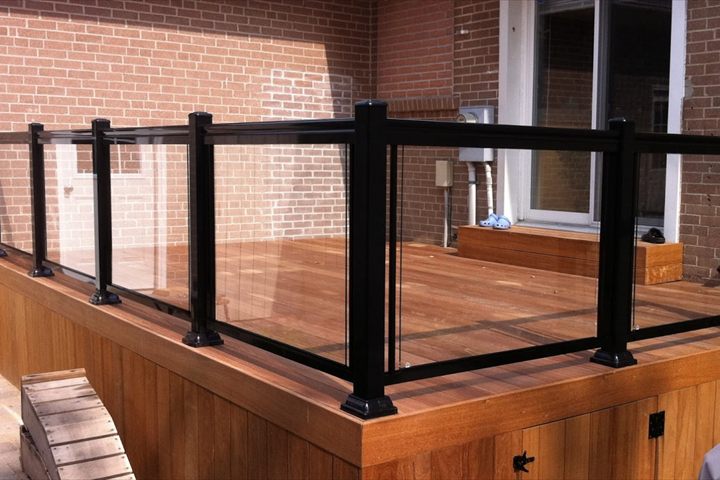
Walkways and porches. A stamped concrete walkway to the front door is a small area that changes how the front of the house looks, and a border in a second colour frames it. Concrete steps can be stamped to match, and if an aluminum railing is going on, the posts are planned before the pour.
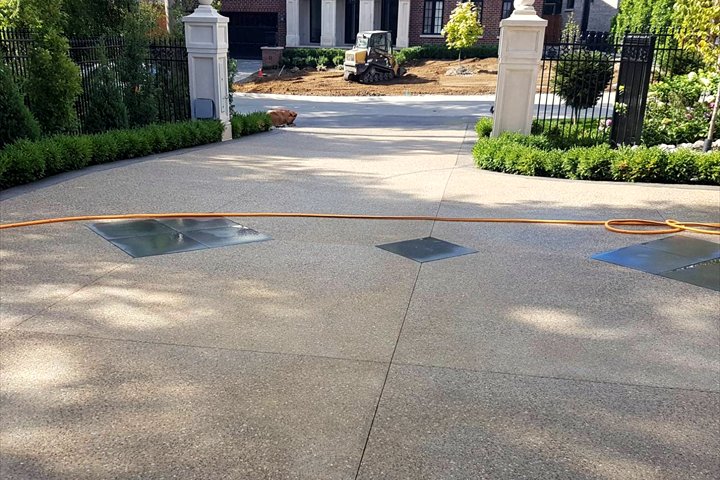
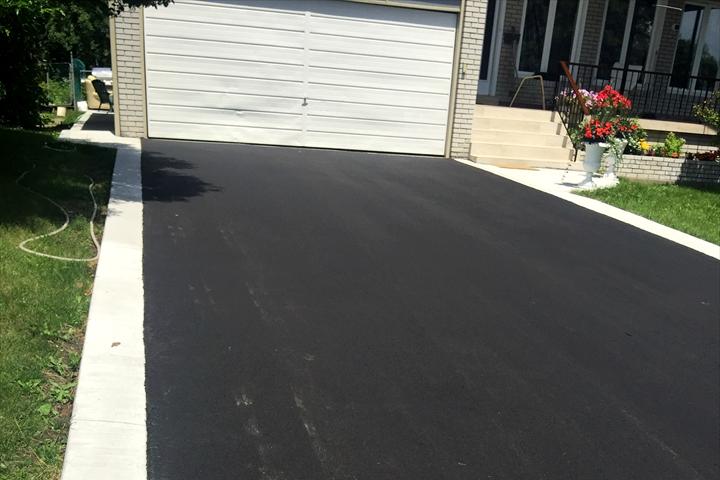
Driveways. A stamped driveway works, with conditions. Tires turning on the spot scuff the surface coating, oil shows on light colours, and a deep texture holds snow. A common approach is to stamp the borders and give the driving lanes a broom or exposed aggregate finish. If your main goal is a durable driveway at a lower cost, an asphalt driveway is worth pricing alongside.
Patterns and colours
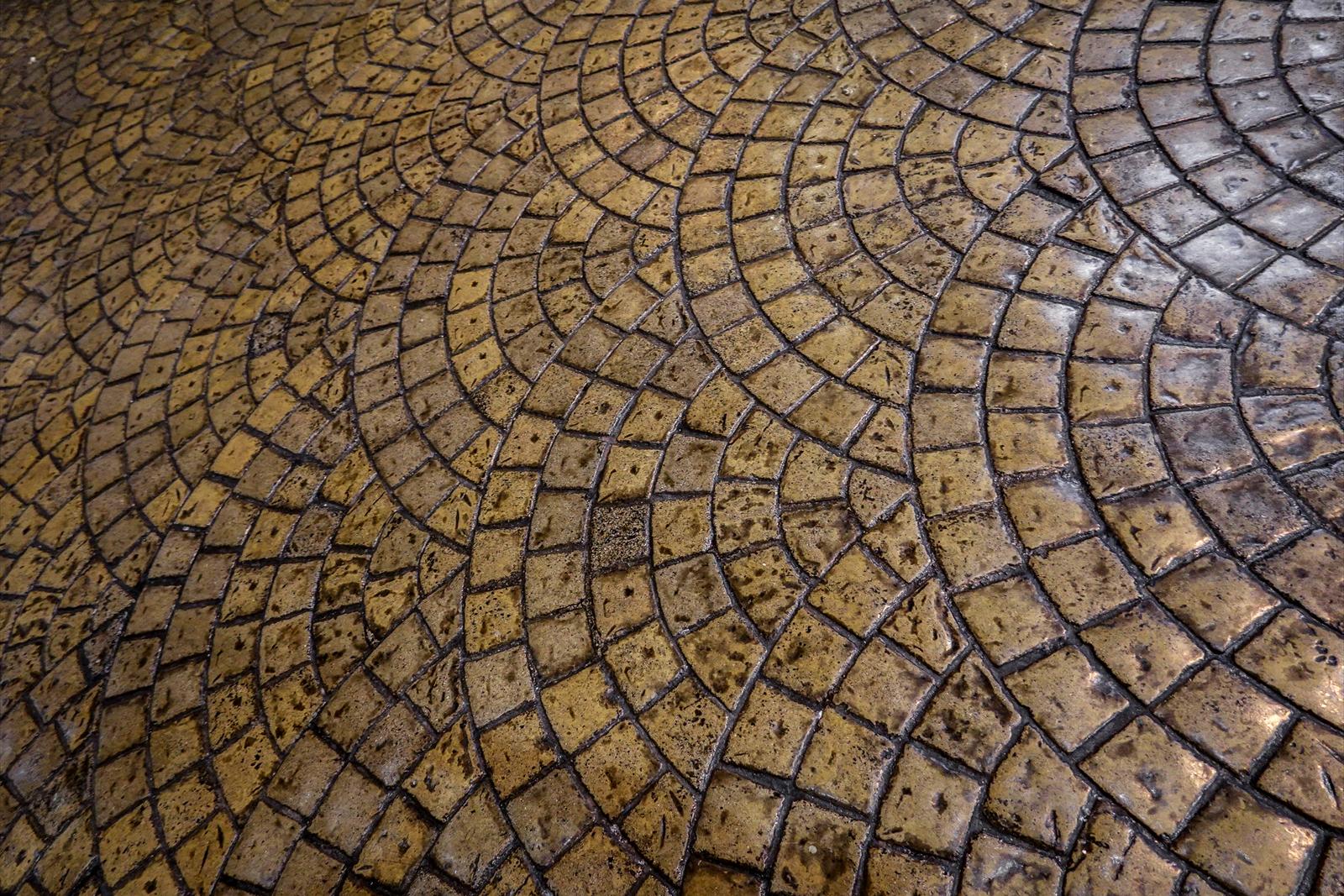
Patterns fall into a few families: stone and slate (ashlar slate, random flagstone), cobblestone and brick (running bond, herringbone, basket weave), fan designs and wood plank. Large, flat patterns look calm on a big area; small, busy ones suit a narrow walkway or a border. Deep textures look the most natural but hold more water and dirt.
Colour is usually chosen as a pair, a base and a darker accent. Earth tones, greys and charcoal are the most forgiving: they hide dirt and tire marks and sit well beside brick and stone. Very light colours show stains. If you can, look at an existing stamped patio in daylight, because a small sample looks different from a whole slab.
How long does stamped concrete colour last?
There is no honest single number. Colour mixed through the whole slab lasts as long as the concrete: if the surface wears, the same colour is underneath. A colour hardener is brighter but sits in the top layer, so wear eventually goes through it. What fades first is the accent and the sheen, worn by sun, traffic, salt and shovels, and a covered porch keeps its colour longer than a driveway in full sun. A sealer is commonly applied to stamped concrete to deepen the colour, and that coating is what dulls first.
Is stamped concrete slippery?
It can be, more than a broom finish, and how much depends on choices made before the pour:
- The pattern. Textured stone and slate grip better than patterns with smooth, flat faces.
- The coating. A high-gloss coating is the slickest surface of all when wet. A matte one is less slick, and a fine anti-slip grit can be mixed in.
- Where it goes. Around a pool, on a slope or on step treads, pick a well-textured pattern, or use a broom finish with a stamped border.
Any concrete with ice on it is slippery, stamped or not. Sand on icy patches gives traction without harming the surface.
Stamped concrete in Ontario winters
Freeze-thaw is the main test. Water that soaks into the surface expands when it freezes, and the low spots of a pattern hold more water than a flat finish. What helps:
- Drainage. A slab with a proper slope dries between storms and holds up far better.
- No de-icers the first winter. New concrete is still gaining strength, so use sand that season.
- Salt with care after that. Use the least that works, avoid de-icers containing ammonium nitrate or ammonium sulphate, which attack concrete, and clear away salty slush that cars drag in.
- Shovel with plastic. A plastic shovel, or a snowblower with its skid shoes set slightly high, won't scrape the pattern.
Stamped concrete, interlock or broom finish
Stamped concrete and interlock are chosen for looks; broom-finished concrete is the practical baseline. We install all three.
| Question | Stamped concrete | Interlock | Broom finish concrete |
|---|---|---|---|
| Look | Stone, slate, brick or wood pattern in one slab. | Real pavers in many shapes and colours. | Light grey, uniform. |
| Grip | Fair to good, depending on pattern and coating. | Good. | The best of the three. |
| Weeds | No open joints. | Sand joints can sprout weeds and need topping up. | No open joints. |
| Cracking | Will crack somewhere; pattern lines hide most of it. | No cracks; pavers move if the base shifts. | Will crack somewhere, along visible straight joints. |
| Repairs | A new section is hard to match. | Pavers lifted, base fixed, same pavers relaid. | A repoured section shows, though less than on a pattern. |
| Cost to install | More than broom finish: colour, mats and labour. | Depends on the paver. Ask us to price it against stamped. | The lowest of the three. |
For more on pavers, see interlocking and interlocking patios.
Getting a stamped concrete quote in Vaughan and nearby
Our office is in Vaughan. We pour stamped concrete in Woodbridge, Maple and Kleinburg, north through Richmond Hill, Aurora and Newmarket, and in Toronto, Mississauga and Brampton. Much of York Region sits on silty, clay-bearing glacial tills that drain slowly and are frost-susceptible, so the base and the slope get as much attention as the pattern on top. To price your job, send:
- Rough measurements or a sketch, and photos of the whole area, including where it meets the house.
- What is there now: grass, or old concrete, asphalt or interlock that has to come out.
- What the surface is for: a dining table, a hot tub, cars, foot traffic.
- Patterns and colours you like, even as screenshots.
- Whether a concrete truck can reach the spot, or the concrete has to be pumped or wheeled in.
Send it through the contact page or the form below. The free written estimate covers the base, slab thickness, reinforcement, pattern and colours, with the expected timeline.