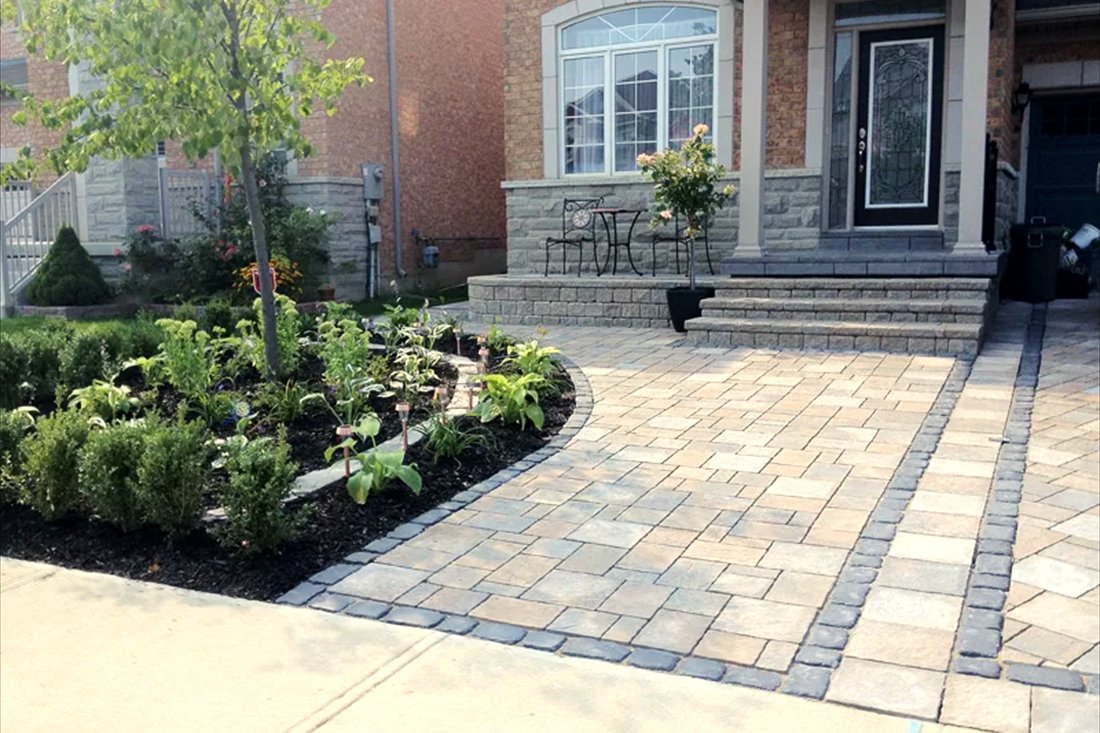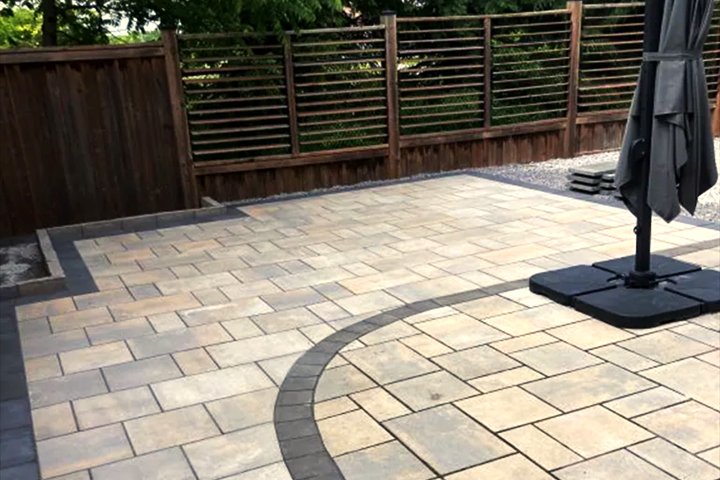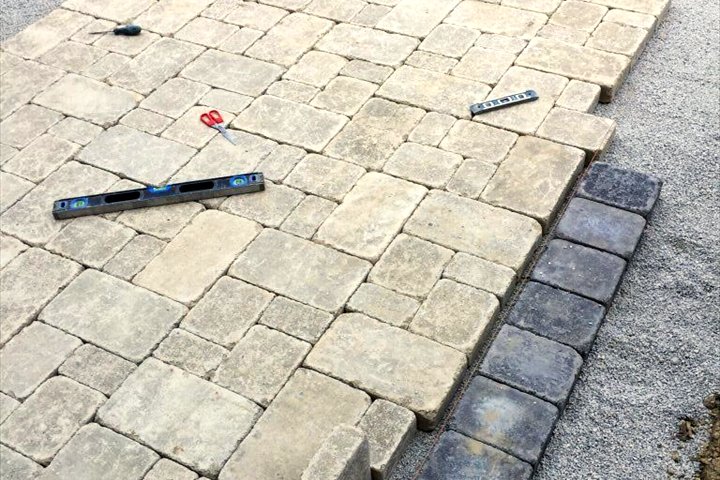
Interlocking is a surface of individual pavers laid tight together on a compacted gravel base. Nothing is poured and nothing is glued. The pavers sit on a screeded bedding layer, an edge restraint stops them spreading, and sand swept into the joints locks each one against its neighbours. That makes the base the whole job: a paver surface is exactly as flat and as stable as the stone underneath it.
We build interlock driveways, patios, walkways, steps and retaining walls across Vaughan, including Woodbridge, Maple and Kleinburg, and across York Region, Toronto and Peel. We also lift and re-level interlock that has sunk or shifted.
Interlock driveways
A driveway is the hardest job interlock is asked to do. Cars load it, tires twist on it when you turn the wheel, and a plow or shovel scrapes it all winter. Three things decide whether it stays flat.
- The base. Soft or wet soil found during excavation comes out first. Geotextile fabric goes over the compacted soil to keep it apart from the base and help drainage. The base itself is 3/4 inch clear gravel, which lets water drain through, compacted in thin lifts of 1 to 2 inches so every layer is firm. A driveway gets a deeper base than a patio.
- The edge restraint. Pavers only stay locked while something holds the outside row in place. When the edge lets go, the joints open and the pavers start to drift.
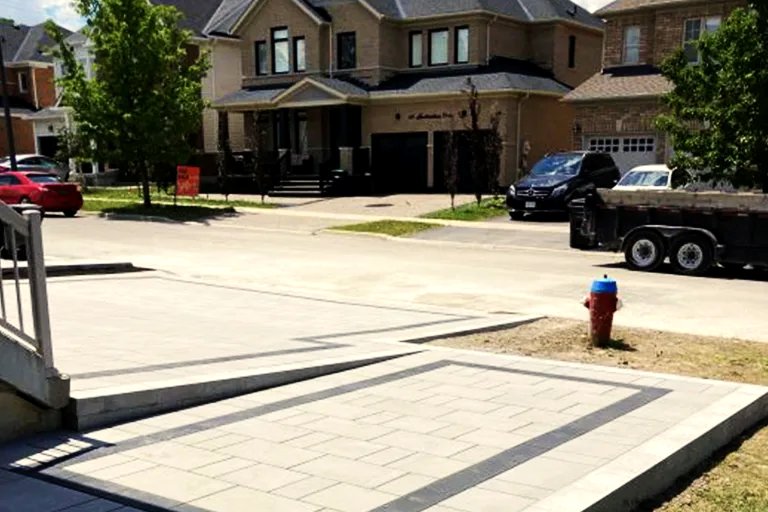
- The paver and the pattern. Pavers made for driveways are thicker than patio stones, and a herringbone pattern holds up best under turning tires because no joint line runs straight through it.
The order of work is the same on every driveway: excavate, lay geotextile fabric, build the clear gravel base in compacted 1 to 2 inch lifts with a slope that sends water away from the house, screed the HPB bedding (small limestone chips) between rails, lay and cut the pavers, sweep in polymeric sand, compact the surface, and sweep in a second coat of polymeric sand right after.
Patios and walkways
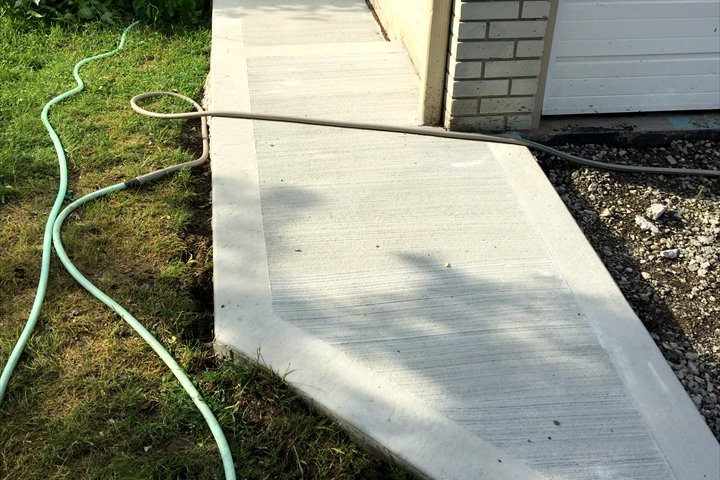
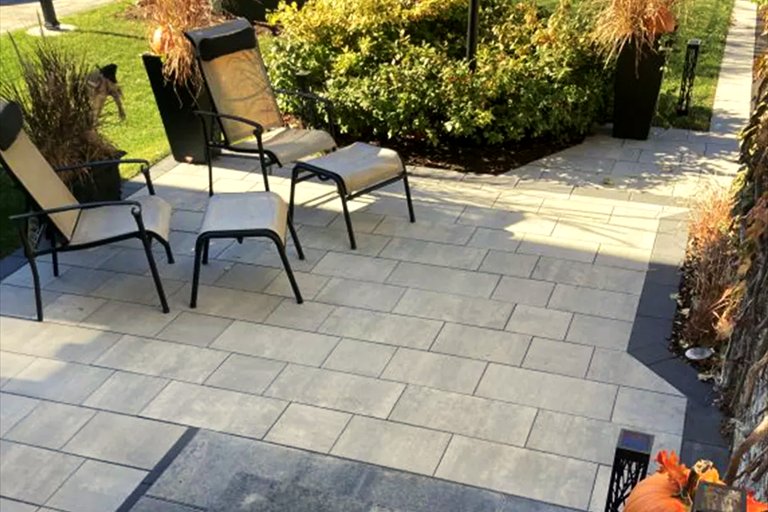
Patios and walkways carry people and furniture, so the base is lighter than a driveway's, but the rules do not change. The surface needs enough slope that water runs off it and away from the foundation, and it needs a firm edge, even where it meets a lawn or a garden bed.
Planning a patio or walkway, from its size and slope to what will sit on it, is covered on our interlocking patios and walkways page.
Interlock steps and retaining walls
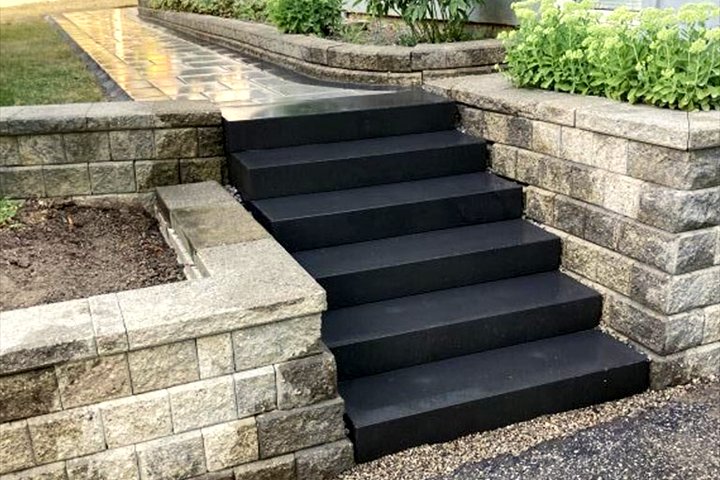
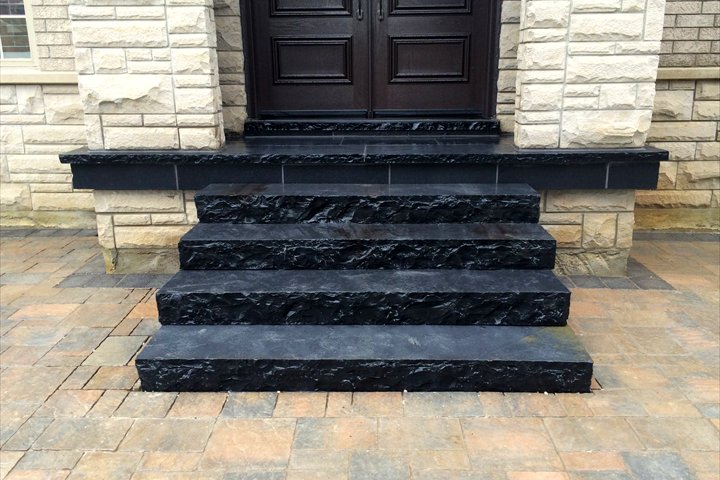
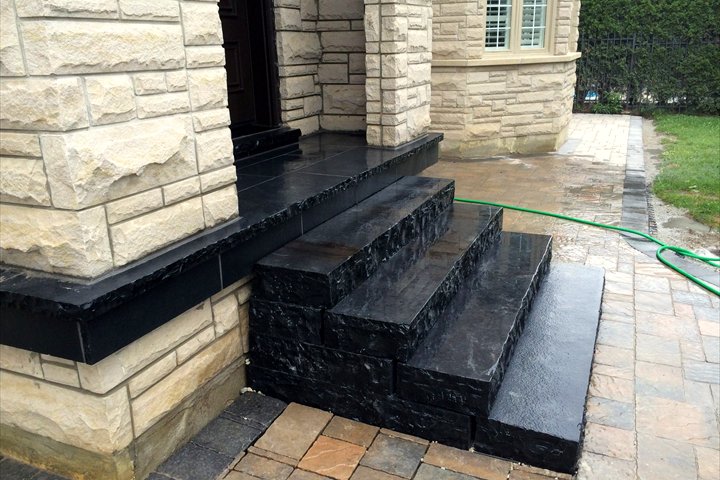
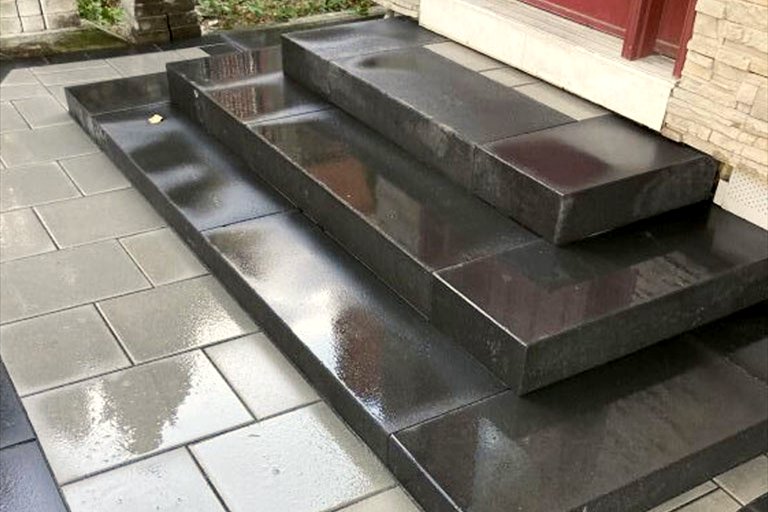
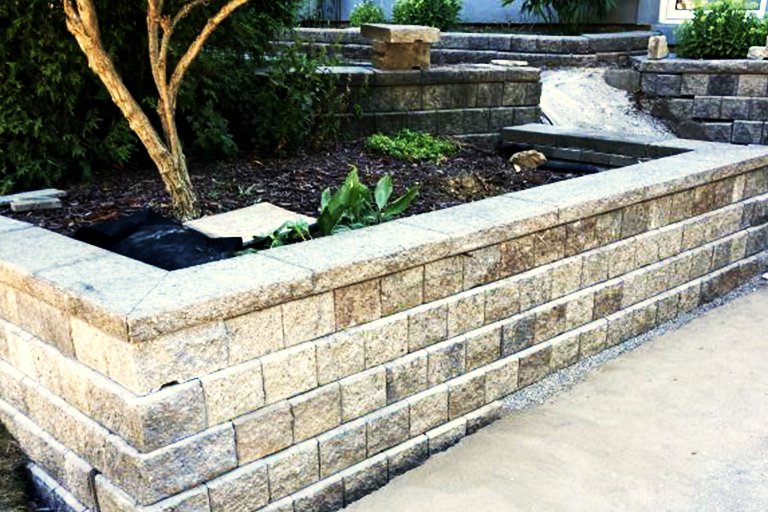
Front steps, porches and garden walls are built from wall block and coping instead of pavers, and they fail for a different reason: water trapped behind them. A wall that leans or bulges has usually been pushed by wet, frozen soil. More on each: interlocking steps and porches and retaining walls and garden walls.
- Steps are built on their own compacted base, with every riser the same height, so no one trips on the odd one. If a railing is going on, we plan where the posts will be anchored before the steps are built. See aluminum railings.
- Retaining walls start with a base course set below ground, and they get clear drainage stone behind them so water has somewhere to go. Taller walls hold back a great deal of weight and are built for it. We tell you on the site visit what yours needs.
Interlock repair and re-levelling
This is the real advantage of interlock: it can be taken apart and put back. Where a section has sunk, we lift the pavers, find out why the base moved, correct and recompact it, and relay the same pavers. Once the joints are sanded, the repair is hard to find.
The usual causes are a base that was too thin or never compacted, a downspout or low spot soaking one area, an edge restraint that has let go, and tree roots. Re-levelling without fixing the cause only buys a season or two. The full process, problem by problem, is on our interlock repair page.
Re-levelling makes sense when the problem is in one or two areas. When pavers have sunk and spread across most of the surface, the base has failed everywhere, and the honest answer is to lift everything, rebuild the base and relay.
What an interlock driveway costs
Interlock is priced job by job, and your free written estimate lists each part of the price so you can compare quotes line for line. It costs more per square foot than asphalt, because every paver is placed and cut by hand. These are the things that move the figure:
- Size and shape. A long straight driveway is quicker to lay than one with curves, corners and a flared entrance, because every edge needs cut pavers.
- What comes out first. An old asphalt or interlock driveway has to be removed and hauled away before the new base goes in.
- The base. A driveway needs a deeper compacted base than a patio, and soft or wet ground found during excavation has to come out.
- The paver. Pavers vary in thickness, finish and colour, and in price.
- Pattern and border. Herringbone and a contrasting border look sharp and hold up well under turning tires, but they take more cutting and more time.
- Extras in the same job. Steps, a walkway, a retaining wall or a railing can all go on one estimate.
Pavers, patterns and borders
Most of what you see in a finished interlock driveway or patio comes down to three choices, and we go through them with you at the site visit.
- The paver. Pavers come in different sizes, thicknesses, textures and colour blends. Driveway pavers are thicker than patio pavers, and large slab-style pavers suit patios and walkways better than driveways.
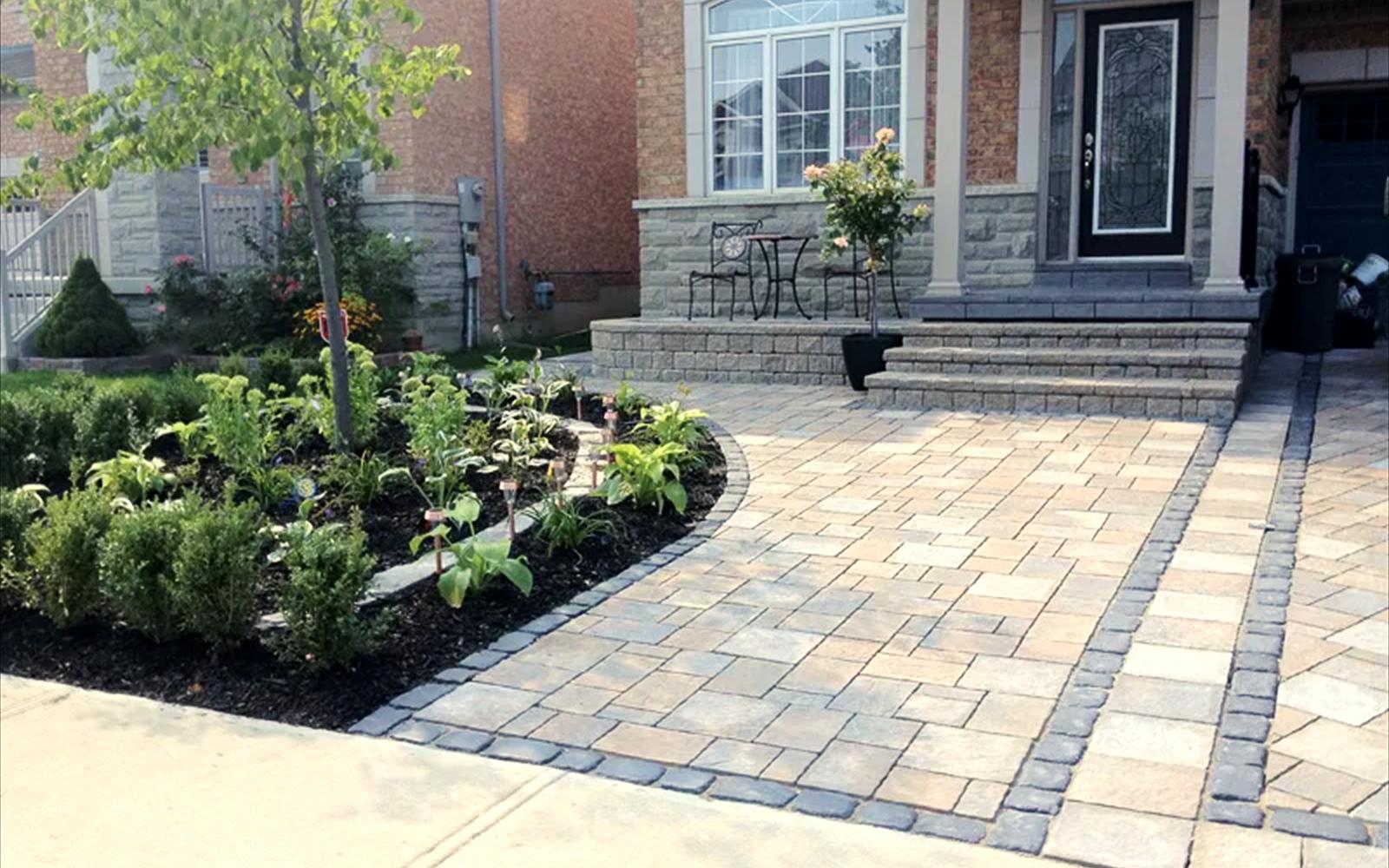
- The pattern. Herringbone is the strongest choice for a driveway, because no joint runs straight through it for a tire to push along. Running bond and basketweave suit walkways and patios, where the load is lighter.
- The border. A soldier course, a row of pavers laid end to end along the edge, frames the surface in a contrasting colour and gives the edge restraint a straight line to hold.
Interlock or asphalt
We install both, so we have no reason to steer you to one. This is how they compare on a driveway.
| Question | Interlock | Asphalt |
|---|---|---|
| Cost to install | Higher. Every paver is placed and cut by hand. | Lower. Our asphalt price range is published. |
| Look | A choice of colours, shapes and patterns. | One smooth black surface. |
| Repairs | Lift, fix the base, relay the same pavers. | Cut out and patch. The patch shows until it fades. |
| Upkeep | Joint sand topped up, weeds pulled from the joints. | Cracks filled before water reaches the base. |
| Snow clearing | Fine with a shovel or blower. A steel plow blade can catch an edge. | Easy to plow and shovel. |
Many homes end up with both: an asphalt driveway for the cars, with an interlock border, walkway or front steps. Because we do both, that is one site visit and one written estimate.
Interlock contractors in Vaughan and York Region
Our office is in Vaughan, so interlock driveways, patios and walkways in Woodbridge, Maple, Kleinburg, Concord and Thornhill are close to home. We also build and repair interlock in Richmond Hill, Aurora, Newmarket, King City, Markham and Whitchurch-Stouffville, and in Toronto, Mississauga and Brampton. If you searched for interlocking near you and you are anywhere in York Region, Toronto or Peel, we cover it.
Before you ask for a quote
Measure the area roughly, and take photos that show the whole space plus anything that has sunk or shifted. Note where water sits after rain and where the downspouts empty. Then send them through the form on this page. The estimate is free and in writing, and it lists what gets excavated, what the base is built from, and what is being laid on top.