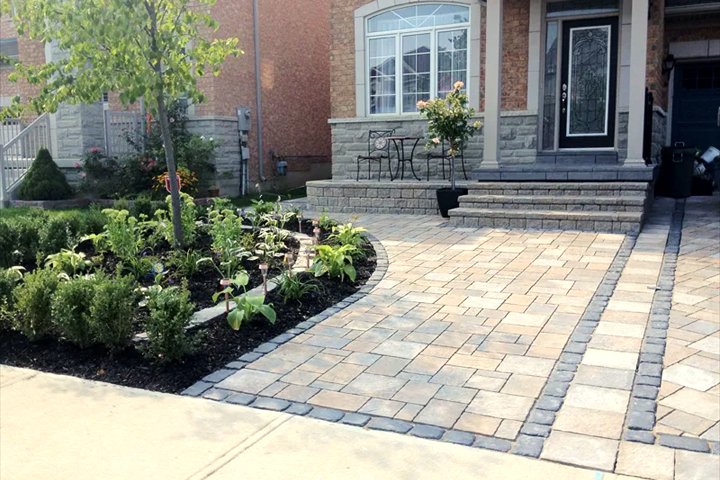
Natural stone steps are cut or split from real stone rather than cast in a factory. Each step is either one solid block of stone or a flagstone tread laid on a built-up step, and no two pieces look quite the same. Homeowners choose them for an entrance that looks like it belongs to the house: deep colour, a rough or rock-faced edge, and a weight underfoot that precast steps don't have. From our office in Vaughan we build natural stone steps, flagstone walkways and landings, and stone porch caps for homes in Woodbridge, Maple, Kleinburg, Concord, Richmond Hill and the towns around them.
Kinds of natural stone steps
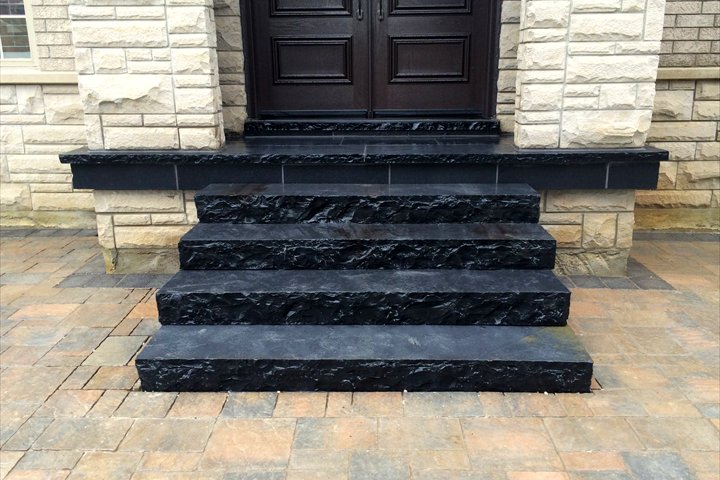
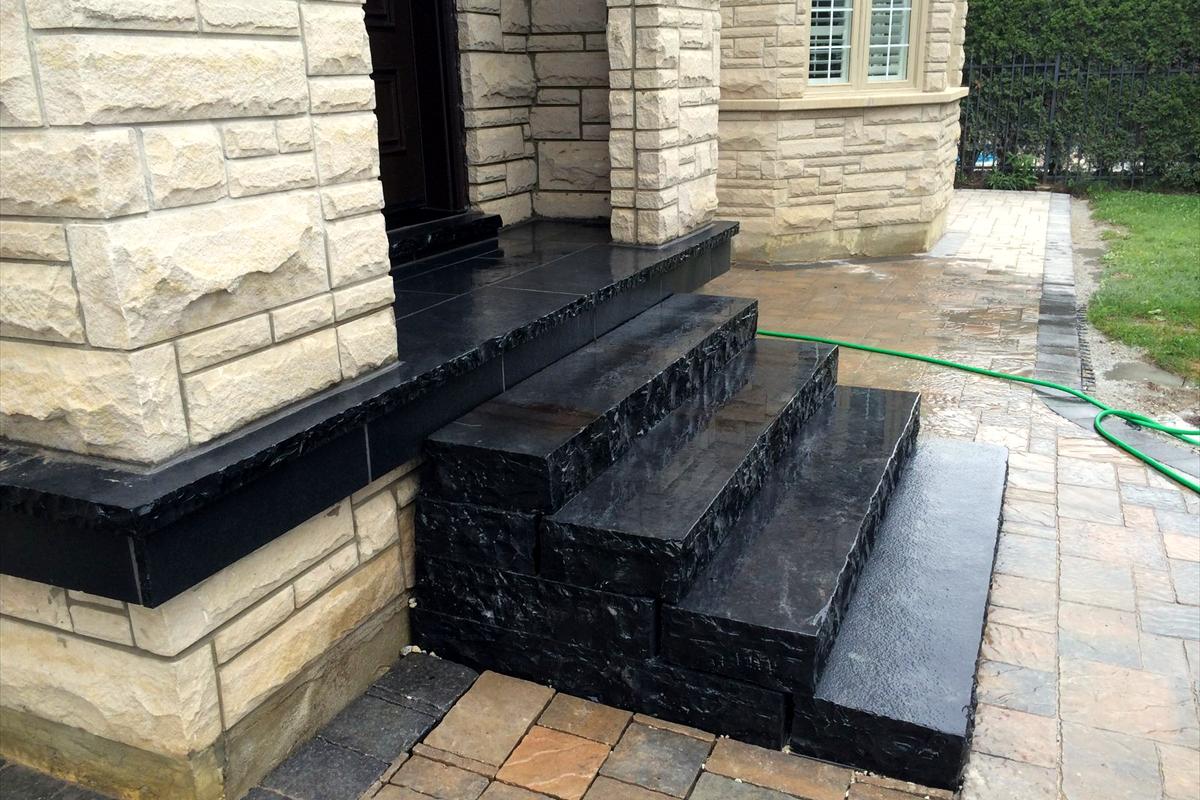
- Solid stone steps. Each step is one block of stone, thick enough to make a full riser by itself. The front edge is often left rock-faced and the top split or flamed so it grips. Solid steps are the heaviest and the simplest: there is nothing under them but the base.
- Flagstone treads on a built-up step. The step is built from block or poured concrete and capped with flagstone, and the risers can be faced with stone too. This suits curved steps, wide landings and steps that wrap around a corner, where one solid piece would be impossible to cut or carry.
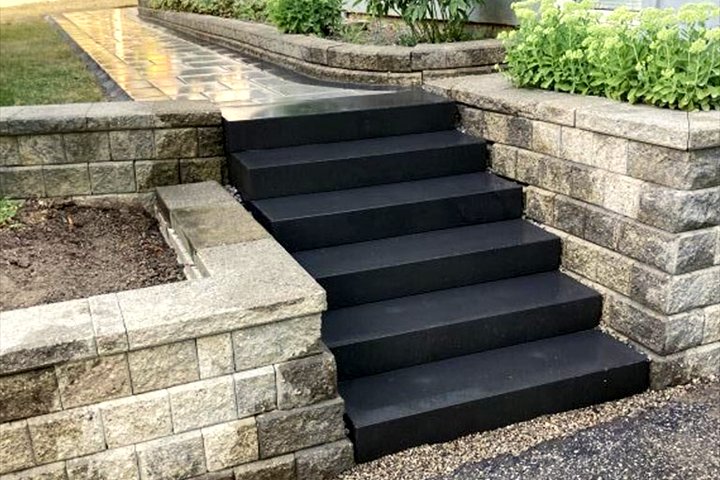
- Steps set into a slope. On a front yard that climbs, solid stone steps can be laid into the hill one behind the other, often with planting or small stone walls on each side, so the steps look like part of the landscape.
Flagstone walkways and landings
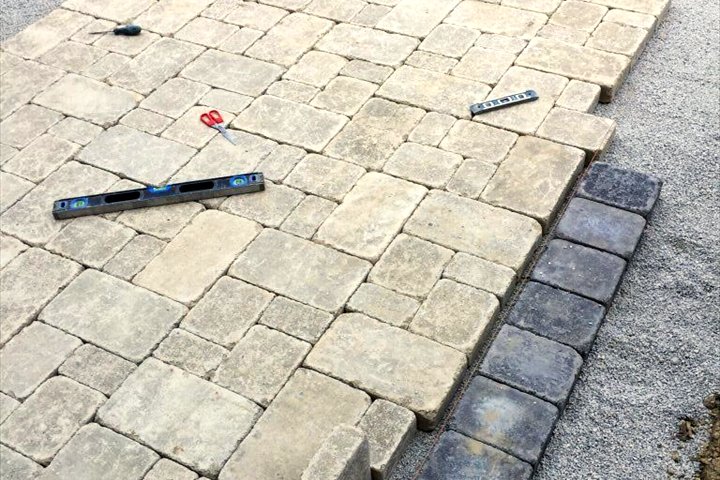
A flagstone walkway uses flat slabs of split stone. Irregular flagstone has natural edges and is fitted together like a puzzle, which suits a garden path or a cottage look. Cut flagstone comes in squares and rectangles and gives a cleaner pattern near the house.
There are two ways to lay it. Dry-laid flagstone sits on a compacted gravel base with screenings swept into the joints; it flexes a little with the ground, and a single stone can be lifted and reset. Flagstone set in mortar on a concrete slab gives tight, even joints and a surface with no movement at all, which is what you want on a landing at the front door or anywhere water runs toward the house. A landing should be deep enough to stand on while the door swings open, so the first step down is never right at the threshold.
Flagstone patios
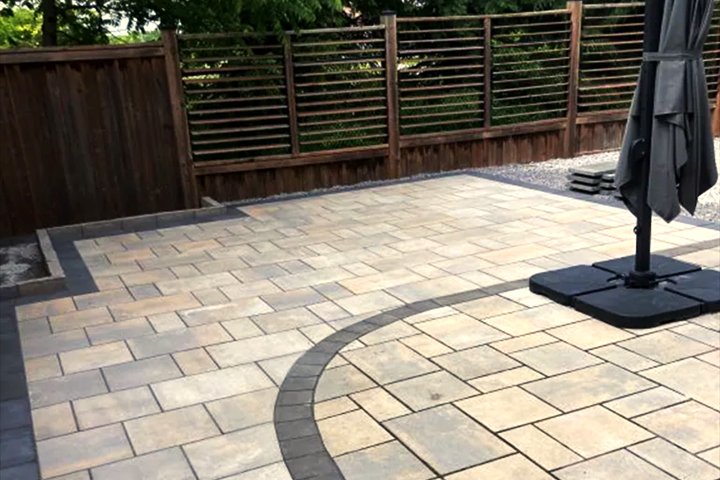
A flagstone patio is laid the same way as a walkway, only bigger: large flat slabs of split stone on a compacted base, either dry-laid with screenings in the joints or set in mortar on a concrete slab. Irregular flags give a relaxed, natural look around a garden or a pool; cut rectangles give a tidier pattern next to the house. Because every slab is a different thickness, each one is bedded and levelled by hand so the surface is flat enough for a table and chairs, with a gentle fall away from the house so rain drains off.
A flagstone patio often goes with the rest of the yard: stone steps down from the back door, a low stone wall or bench along one side, or an outdoor kitchen or fire table set on the same stone. If you would rather have pavers, our interlocking patios page covers that option.
Porch caps, wall caps and stone benches
A tired concrete porch can be topped with natural stone if the slab under it is sound. The flagstone is set in mortar, with a thicker stone or a cut edge along the front so it reads as one solid piece. The same stone can cap the low walls beside the steps or the top of a retaining wall, which ties the entrance together. A single long slab of stone set on two solid blocks makes a bench that stays put through every winter.
Where the porch concrete is cracked through or has dropped, the stone will crack with it, so the old porch comes out first. Our concrete steps page covers rebuilding the concrete underneath.
How we build natural stone steps
Stone is heavy, and heavy things settle if the ground under them can. The old steps and the soft soil come out, and the steps go on a compacted gravel base that reaches past the front of the bottom step, so the first step has as much support as the last. Each solid step overlaps the one below it and bears on it, which locks the flight together.
Large pieces are lifted and set with a machine, then levelled by hand. Every riser is kept the same height, because one step that is taller or shorter than the rest is the step people trip on. Each tread gets a slight fall toward the front so rain runs off rather than pooling against the house or freezing on the step. Where the steps meet a walkway or interlock driveway, the levels are set so there is no lip to catch a foot or a snow shovel.
Natural stone or pavers
Both are good choices; they suit different houses and budgets.
- Look. Natural stone has variation in colour and texture that a cast product imitates but does not match. Precast slabs and pavers are uniform, which is easier to match to an existing driveway.
- Weight and feel. A solid stone step is far heavier than a precast slab of the same size, so it feels solid underfoot and does not rock.
- Cost. Natural stone usually costs more, for the material and for the handling. Our interlock steps page covers the precast option.
- Repairs. A broken paver can be swapped from the same run. A natural stone piece can be replaced too, but the new one will never be an exact twin of the old.
Many entrances mix the two: stone steps and a stone landing at the door, with an interlock walkway or patio leading to them. Our patios and walkways page shows the paver side.
Railings on stone steps
A handrail makes stone steps easier to use on an icy morning, and it is easiest to fit when it is planned with the steps. Posts are anchored into holes drilled into the stone or mounted on the face of a step, and each one needs solid stone around it, away from edges and natural seams. We install aluminum railings and glass railings on stone steps, in black, bronze and other colours to suit the stone.
Winter care for natural stone
Rock salt is hard on some natural stone. Softer stones such as limestone and sandstone can flake at the surface when salty meltwater freezes in them over and over. Clear snow with a plastic shovel or a broom, and for ice use sand or a de-icer that its label says is safe for natural stone. Keep downspouts and snow piles from draining across the steps, since water that crosses a step at night is ice by morning. A split or flamed surface helps too: it keeps its grip in wet weather where a smooth one would not.
Quote for natural stone steps in Vaughan
What moves the price of natural stone steps:
- The stone. Solid steps cost more than flagstone treads on a built-up step, and the type and finish of the stone matter.
- Size and shape. The number of steps, their width, and any curves or corners that mean more cutting.
- What comes out first. Old precast, concrete or interlock steps have to be removed and hauled away.
- Access. Big pieces are set with a machine, so a narrow side yard or a long carry from the street changes how they get there.
- Extras. A landing, a walkway, porch caps, a railing or a wall beside the steps.
Besides Vaughan, we build natural stone steps in Richmond Hill, Aurora, Newmarket, King City, Markham, Toronto, Mississauga and Brampton. For a quote, use the form below or the contact page and include a photo of the entrance, the height from the ground to the door sill, what is there now, and any railing or walkway you want with it. We measure on site and send the estimate in writing.